

Web scraping looks trivial in small tests. You write a script, fetch a few pages, and everything works. Then production conditions hit hard. Blocking systems detect your request patterns within minutes. JavaScript-heavy pages return empty divs instead of actual content. Scaling from hundreds to millions of requests exposes every shortcut you took during initial development. The gap between a working script and a reliable production pipeline is wider than most teams anticipate.
This article first explains why data extraction setups break when they scale beyond toy examples. Understanding failure mechanics helps separate meaningful features from marketing fluff. Then we present a curated list of APIs that actually handle real-world conditions without constant babysitting. The selection prioritizes stability under pressure, automation of tedious infrastructure work, and the ability to operate when target websites actively resist data extraction.
Why Scraping Breaks When It Scales
Most scraping failures trace back to structural weaknesses rather than random bad luck. Anti-bot systems analyze request patterns, header consistency, and IP reputation across entire sessions. Your script might work flawlessly for the first thousand requests before fingerprinting algorithms flag it as automated traffic. Request patterns that look human at a small scale become obvious bot behavior when volume increases by two orders of magnitude.
Issues appear gradually and then all at once. Success rates drift downward from ninety-eight percent to something far less usable. Costs climb as retry logic burns through proxy bandwidth without delivering clean data. Outputs become unstable and incomplete without obvious error messages explaining why. Teams waste hours debugging intermittent failures that stem from infrastructure limitations rather than code defects. The most common failure patterns emerge from predictable weaknesses in scraping architecture.
Common Failure Patterns in Production Scraping
Production scraping exposes weaknesses that never surface during controlled testing. Teams often blame specific websites or temporary blocks when the real problem lies deeper. The same issues appear across industries, project sizes, and technical stacks because they stem from shared architectural blind spots. Recognizing these patterns early prevents months of firefighting.
The most common ways scraping setups fail in production include:
- Weak proxy management leading to frequent blocking;
- Inability to handle JavaScript-heavy pages;
- Poor scaling under high request volume;
- Fragile parsing logic that breaks on small layout changes;
- Lack of automation for retries and error handling.
These patterns usually appear together and worsen over time if nobody addresses the root causes.
What Actually Matters in a Web Scraping API
Feature lists alone rarely tell the full story. Every vendor claims high success rates and global coverage. These statements mean nothing without understanding how the system performs when target websites actively defend against scraping. Production scraping depends on three things: infrastructure stability, automation depth, and the API’s ability to absorb complexity on your behalf.
Strong APIs remove operational burden rather than adding new layers of configuration. The platform should handle proxy rotation, rendering decisions, and retry logic without requiring constant tuning. Every minute your team spends managing scraping infrastructure is a minute not spent analyzing data or building actual product features.
Core Capabilities to Look For
Evaluating scraping APIs requires looking past marketing materials toward capabilities that determine real-world reliability. The vendors that survive production conditions share specific technical approaches to common problems. These capabilities separate tools that work consistently from those that work only under ideal circumstances.
When evaluating a web scraping API, focus on:
- Reliable proxy rotation across different IP types;
- Ability to bypass anti-bot protections;
- JavaScript rendering for dynamic content;
- Scalable request handling without performance drops;
- Flexible output formats and data extraction options.
These capabilities determine whether scraping works beyond simple use cases that any beginner script could handle.
Top 7 Web Scraping APIs That Hold Up in Production
Not all scraping APIs are built for the same conditions. Some prioritize ease of use, others focus on infrastructure depth or data extraction quality. The difference becomes obvious once systems move beyond small-scale tests and start dealing with blocking, dynamic content, and unpredictable workloads.
The tools in this list were selected based on how they perform under those constraints rather than how they look in demos. Each one reflects a different approach to handling production scraping, from full automation to network-level reliability. The goal is not to rank them by popularity, but to highlight where each solution actually fits.
1. HasData
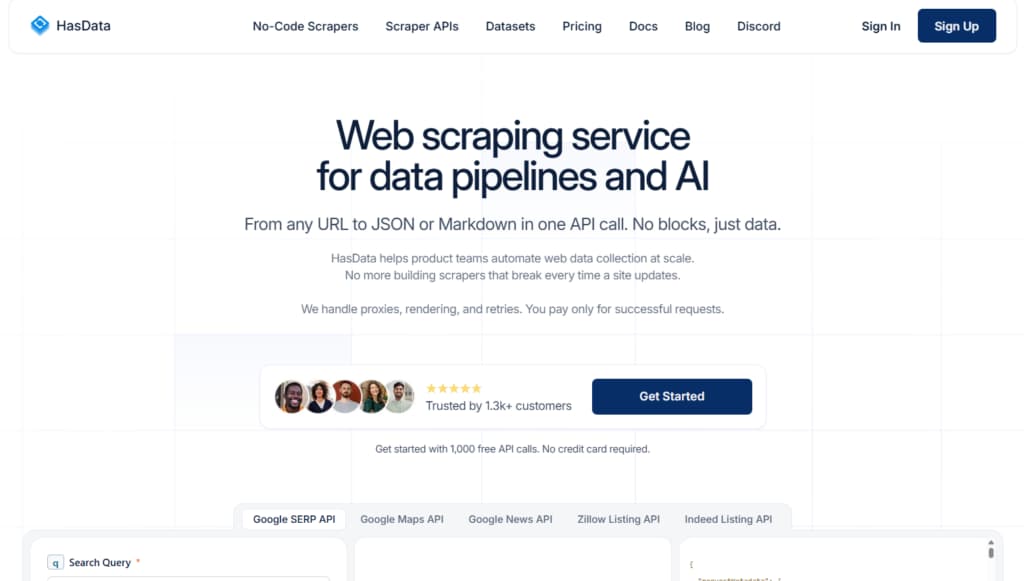
HasData Web Scraping API is designed specifically for large-scale scraping through a unified API endpoint. The system handles proxies, blocking countermeasures, content rendering, and page interactions internally without forcing users to manage separate components. This becomes critical once scraping moves from experiments to production systems. A system that fails intermittently creates operational debt that compounds faster than anyone expects.
The platform abstracts away infrastructure management while maintaining enough flexibility to handle diverse targets. HasData positions itself for environments where scraping must work consistently without engineering teams dedicating cycles to maintenance and troubleshooting.
Handling Real-World Scraping Conditions
Scaling introduces layers of complexity that manual setups simply cannot handle over extended periods. Proxy rotation alone becomes a full-time operational concern when request volumes climb. Anti-bot bypass requires constant adaptation as defensive systems evolve their detection methods. Maintaining custom infrastructure while also delivering business value creates an unsustainable tension.
The API supports production scraping through:
- Single API request for large-scale data collection;
- Automatic proxy rotation;
- Bypass of anti-bot systems like Cloudflare and DataDome;
- JavaScript rendering for dynamic pages;
- AI-based data extraction;
- Batch scraping and page interactions.
This reduces infrastructure overhead and improves consistency across scraping operations.
2. Apify
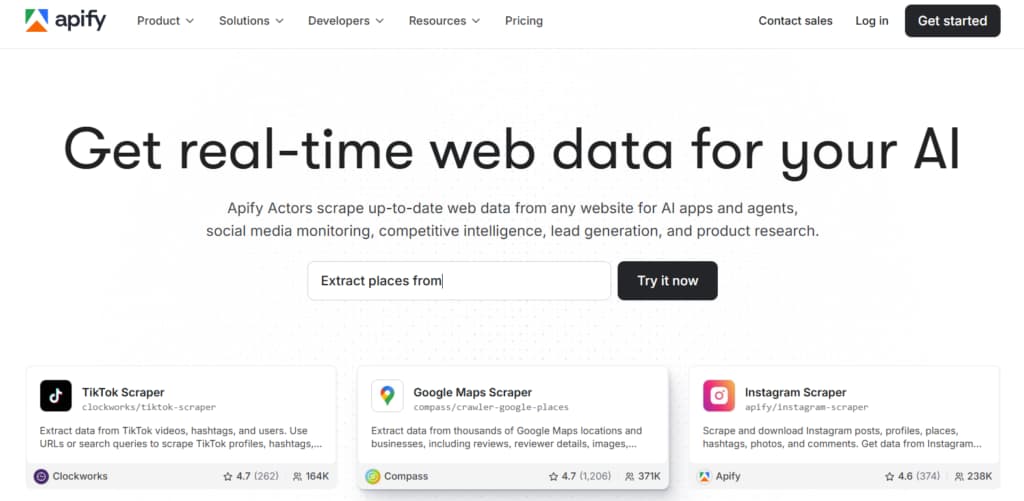
Apify combines scraping APIs with full automation workflows and custom actor development capabilities. Their platform extends beyond simple request-response patterns toward complete data extraction pipelines that schedule, monitor, and adapt to changing conditions. The actor model lets teams encapsulate scraping logic into reusable components that handle complex site navigation and data transformation sequences.
This approach suits organizations that need more control over workflow logic than basic APIs provide. The tradeoff involves increased complexity during initial setup. Apify rewards that investment with flexibility that simpler platforms cannot match when requirements grow strange.
Flexible Automation and Workflow Control
Custom scraping actors represent the platform’s defining characteristic. Teams build modular components that handle specific sites or extraction patterns, then compose them into larger workflows. The system manages execution, scheduling, and integration with downstream data processing.
Its approach includes:
- Custom scraping actors;
- Scheduling and automation;
- Integration with data pipelines;
- Scalable execution.
This allows more control over complex workflows that basic request APIs cannot accommodate.
3. Diffbot

Diffbot approaches scraping through the lens of automated data structuring rather than raw page retrieval. Their AI-driven extraction engine identifies content types, interprets page structure, and outputs clean, structured data without requiring custom selectors or parsing logic. This distinction matters because writing and maintaining extraction rules consumes disproportionate engineering resources over time.
The platform targets use cases where the data structure holds more value than raw HTML access. Teams that need consistently formatted outputs across diverse sources gravitate toward this approach.
Automated Data Structuring
Extracting usable information from messy web pages represents the most brittle component of most scraping operations. Site updates break selectors constantly. Nested layouts confuse simple parsing logic. Diffbot’s AI models abstract away these concerns by understanding page structure semantically rather than syntactically.
Its strengths include:
- AI-driven content extraction;
- Automatic parsing of pages;
- Structured data outputs;
- Reduced need for custom selectors.
This simplifies data extraction workflows for complex pages with inconsistent markup.
4. NetNut
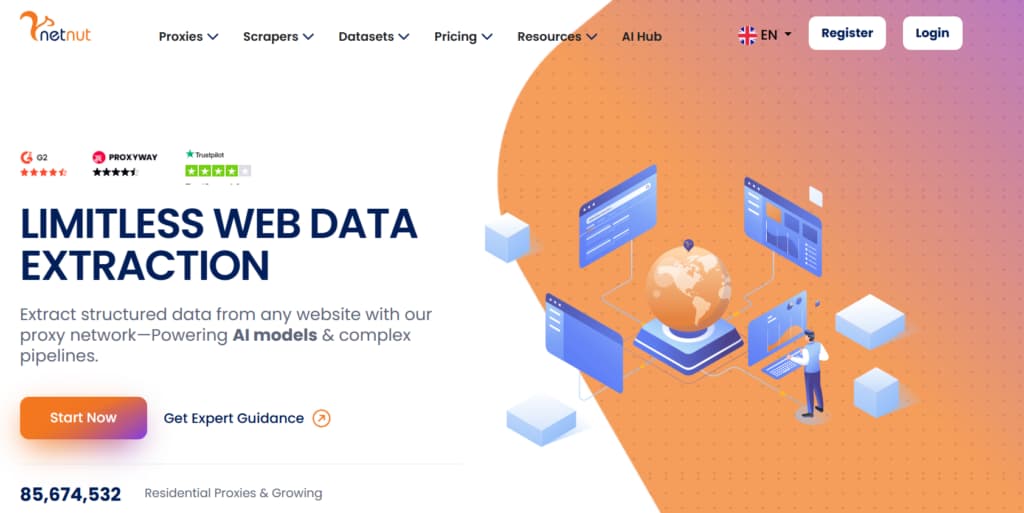
NetNut focuses intensively on proxy infrastructure stability rather than feature breadth. Their network routes requests through ISP-level connections rather than conventional datacenter or residential proxy pools. This approach improves success rates on websites that aggressively block standard proxy traffic. The tradeoff involves less flexibility in certain targeting scenarios.
Organizations where the request success rate directly impacts business outcomes value this reliability focus. NetNut’s positioning emphasizes network quality over auxiliary features.
Stable Network-Level Access
Proxy quality determines scraping success more than any other single variable. Datacenter IPs trigger blocks almost immediately on defended targets. Residential proxies work better but introduce latency and cost considerations. ISP-level connections occupy a middle ground with distinct uptime advantages.
Its capabilities include:
- ISP-level proxy connections;
- High success rates;
- Stable connections under load;
- Global coverage.
This improves reliability at scale for operations where consistency outweighs configurability.
5. Smartproxy Web Scraping API

Smartproxy built their scraping API atop an established proxy infrastructure footprint. The platform balances ease of deployment with sufficient scale for production workloads. Their approach simplifies the transition from small tests to larger operations by keeping the same interface while scaling infrastructure behind the scenes.
Teams that need quick integration without sacrificing growth potential find this middle ground appealing. The API handles proxy logistics while exposing enough parameters for targeted optimization.
Balanced Simplicity and Scale
Extreme simplicity often caps upward scalability. Extreme configurability delays initial deployment. Smartproxy targets the space between these poles with an API that starts simple and scales without requiring fundamental architectural changes.
It offers:
- Proxy-based scraping API;
- Easy integration;
- Scalable request handling;
- Global targeting.
This balances usability and performance for teams anticipating growth beyond the initial project scope.
6. Crawlbase
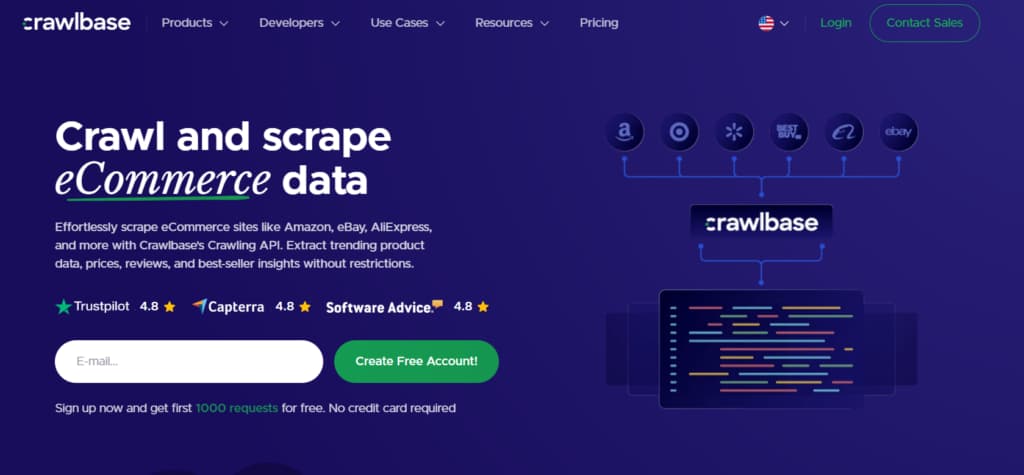
Crawlbase emphasizes automated request handling and intelligent retry logic as core differentiators. Their platform focuses on reducing failure rates through sophisticated error recovery rather than just throwing more proxies at problems. The system analyzes failure patterns and adapts retry strategies based on observed blocking behavior from target websites.
This reduces operational costs by avoiding wasteful retry attempts that burn resources without improving outcomes. Teams frustrated by unpredictable failure modes benefit from this systematic handling of edge cases.
Automated Request Handling
Failed requests consume time and money without delivering value. Smart retry logic distinguishes between temporary network issues requiring simple retries and blocking events demanding strategy changes. Crawlbase automates these distinctions rather than forcing developers to implement complex error handling.
Its strengths include:
- Automatic retries;
- Proxy management;
- Request handling;
- Simplified scraping logic.
This reduces failure rates in production environments where naive retry approaches compound problems.
7. ParseHub API
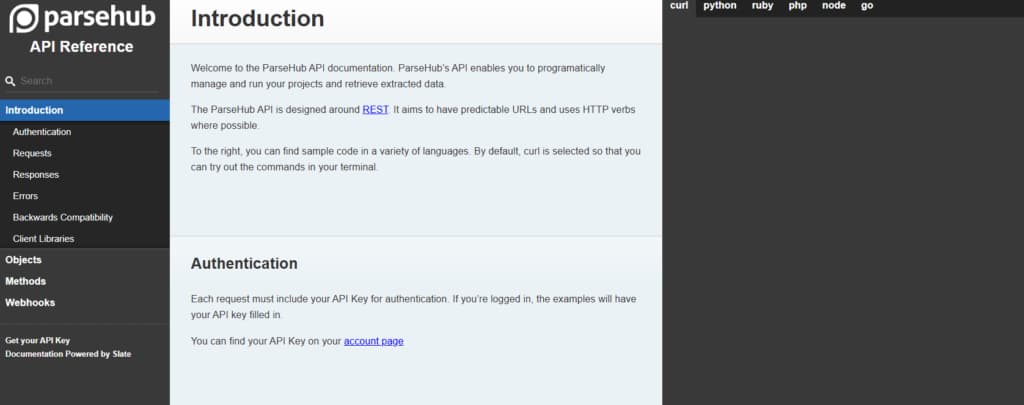
ParseHub focuses on extracting data from complex website structures through visual selection tools and sophisticated navigation logic. Their API exposes these capabilities programmatically for teams that need to scrape targets with intricate page hierarchies, authentication flows, or multi-step interaction sequences. The visual builder generates extraction logic that survives moderate layout changes better than brittle CSS selectors.
This suits use cases where the target website complexity exceeds what simple scraping tools reasonably handle. The learning curve is higher than basic APIs but still lower than building custom automation from scratch.
Handling Complex Page Structures
Some websites actively resist scraping through technical barriers. Others present extraction challenges simply through complex information architecture and dynamic loading patterns. ParseHub addresses both categories through navigation primitives designed for intricate page interactions.
It supports:
- Visual data extraction;
- Dynamic content scraping;
- Flexible parsing logic;
- Complex site navigation.
This helps extract data from difficult targets where simpler approaches consistently fail.
Final Thoughts
Scraping APIs reveal their true character only after deployment to production conditions. Demo environments mask every weakness that eventually causes outages and incomplete datasets. Real reliability emerges from stable infrastructure, deep automation, and operational maturity rather than long feature lists.
Scalability determines whether today’s solution survives tomorrow’s requirements. Pick tools based on how they perform when target websites actively resist extraction rather than how they behave during controlled tests. The gap between those scenarios defines whether scraping becomes sustainable or just another maintenance nightmare.