

Learning management systems no longer function as simple course repositories. Today’s LMS operate as SaaS products, internal training engines, revenue tools, and parts of larger product ecosystems. Off-the-shelf platforms frequently fail when you need custom logic or serious scale. According to our analysts, many companies discover this only after hitting hard limits with user growth or niche workflows.
Businesses don’t actually need ready-made platforms. They need development partners capable of building LMS as genuine products. AI capabilities, advanced analytics, seamless integrations, and real scalability separate useful systems from expensive headaches. Below is a list of companies that actually deliver on these fronts.
Why Businesses Choose Custom LMS Development Over Ready Solutions
Companies move away from SaaS LMS for pretty clear reasons. Off-the-shelf options limit customization, struggle with scale, and make integrations painful. An LMS should embed into your business logic, not sit awkwardly beside it. We see this mismatch constantly in mid-market firms trying to force square pegs into round holes.
Think about what happens when your training needs outgrow someone else’s roadmap. You wait. Or you pay for features nobody asked for. Custom LMS development solves specific problems that vendors ignore. Maybe you need learning paths tied directly to sales performance. Maybe compliance tracking must sync with HRIS every hour. Ready-made solutions rarely handle this well.
Key reasons companies choose custom LMS development:
- Full control over business logic and workflows;
- Ability to scale with growing user base and data load;
- Deep integrations with CRM, HRIS, and internal systems;
- Advanced analytics and AI-driven personalization;
- Ownership of product and monetization models.
Custom solutions give you control and flexibility that off-the-shelf products simply cannot match.
What Defines a Strong LMS Development Company in 2026
Look for EdTech experience, SaaS expertise, AI capabilities, and cloud know-how. Modern LMS platforms include personalization, automation, and data pipelines as standard features. According to our data, the gap between basic and advanced systems keeps widening each year.
You shouldn’t evaluate these companies on “development” alone. Product thinking matters more. A firm that builds features without understanding learning behavior will waste your budget. The best partners ask hard questions about your users before writing any code. They also understand that LMS platforms live or die on data architecture.
Key factors to evaluate LMS development companies:
- Experience building scalable SaaS platforms;
- Strong expertise in AI, data, and analytics;
- Ability to design custom user flows and learning paths;
- Cloud-native architecture and DevOps capabilities;
- Proven track record with enterprise or funded startups.
We used these criteria to rank the companies below.
Top 5 LMS Development Companies
Below is a selection of LMS development companies that consistently deliver scalable and product-focused learning platforms. These teams go beyond basic implementation and focus on building systems that support growth, integrations, and long-term use.
We start with a company that combines strong engineering, AI capabilities, and experience across both startups and enterprise products.
1. Geniusee
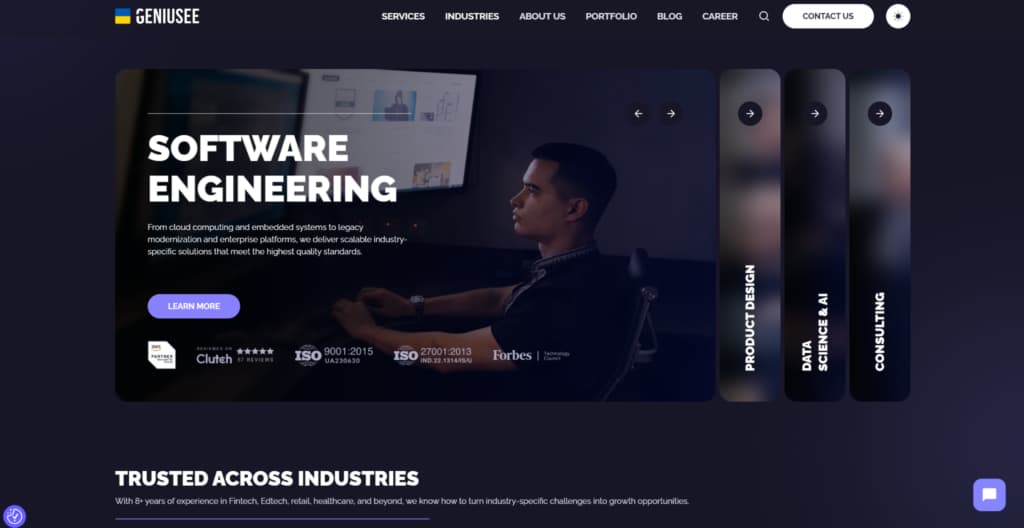
Founded in 2017, Geniusee employs 300+ specialists across 180+ completed projects. The company focuses on custom LMS, AI integration, and SaaS platforms, delivered through its Geniusee LMS development services. They work with Y Combinator startups, a16z portfolio companies, and enterprise clients.
Capabilities and Approach
Geniusee operates as a product partner rather than a typical development shop. That means they care about retention, engagement, and monetization—not just shipping features. Their technical team asks about your growth trajectory before recommending any architecture. This approach saves money long-term, even if it slows down initial sprints.
Core strengths:
- Custom LMS and EdTech platform development;
- AI-powered learning systems and personalization;
- Cloud-native architecture with AWS expertise;
- Data engineering and analytics integration;
- Full-cycle development from discovery to scaling.
They build LMS as complete products, not feature lists.
Best Fit
Geniusee works well for funded startups launching new LMS products. They also fit SaaS companies needing to rebuild legacy platforms. Enterprise training teams with complex logic requirements should consider them too.
2. Accenture
Accenture delivers enterprise-scale digital transformation globally. Their LMS work typically sits inside larger system implementations rather than standalone products.
Capabilities and Focus
Enterprise integration is where Accenture excels. They handle compliance-heavy industries like finance and healthcare with ease. According to our analysts, their consulting-led approach works best when you need process redesign alongside technology. Smaller companies may find their engagement model too heavy for simple LMS builds.
Enterprise strengths:
- Large-scale LMS implementations;
- Integration with enterprise ecosystems;
- Advanced analytics and reporting systems;
- Compliance and corporate training solutions;
- Global delivery and consulting.
Large corporations with complex procurement needs will find Accenture a natural fit.
3. EPAM Systems
EPAM ranks among the largest engineering companies in Eastern Europe with strong digital platform focus. Their EdTech practice has grown significantly over the past five years.
Capabilities and Focus
EPAM brings serious engineering discipline to LMS development. Their UX design team often surprises clients who expect only backend strength. The company delivers well for organizations needing both learning platform and broader digital transformation. Integration with existing enterprise systems comes as standard practice here.
Key capabilities:
- Custom LMS and digital learning ecosystems;
- Strong engineering and UX design;
- Integration with enterprise systems;
- Data-driven learning solutions;
- Global delivery model.
Complex, multi-system learning environments suit EPAM best.
4. Simform
Simform operates as a mid-to-large custom development shop with strong SaaS focus. They build product teams for clients rather than just executing tickets.
Capabilities and Focus
Product development methodology defines how Simform approaches LMS projects. They emphasize cloud infrastructure and DevOps from day one. Their backend architects design for scale even when early-stage startups push back on cost. According to our data, this forward-looking approach saves money during growth phases.
- Core strengths:
- SaaS LMS platform development;
- Cloud and DevOps expertise;
- Agile product development;
- Scalable backend architecture;
- API-first integrations.
Growing SaaS companies looking for a long-term technical partner should evaluate Simform carefully.
5. Infinum
Infinum operates as a digital product studio based in Europe. Their UX/UI work consistently ranks above typical development shops.
Capabilities and Focus
Product-focused design sets Infinum apart from engineering-led competitors. They build learning platforms where user experience drives retention. Mobile-first thinking permeates their architecture decisions. According to our analysts, companies with design-heavy requirements often struggle with traditional LMS vendors but find Infinum refreshingly different.
- Key strengths:
- Product-focused LMS design;
- UX/UI-driven learning platforms;
- Mobile-first learning systems;
- Custom integrations and APIs;
- Full-cycle digital product development.
UX-heavy LMS products with demanding user experience requirements match Infinum’s sweet spot.
How to Choose the Right LMS Development Company
Your choice depends on product stage, budget, and system complexity. Price matters less than fit. According to our data, companies that pick solely on hourly rates spend twice as much on fixes later. You need someone who understands learning behavior, not just code.
- Key questions to ask before choosing:
- Do they have experience with LMS or EdTech products;
- Can they build scalable SaaS architecture;
- Do they offer AI and data capabilities;
- How do they handle integrations and APIs;
- Can they support long-term product growth.
Asking these questions upfront prevents expensive mismatches down the road.
Final Thoughts
An LMS is a product, not just a tool. Custom solutions win for companies serious about learning as a business function. Choose your development partner based on product thinking, not development volume alone. The right partner builds something that grows with you. The wrong partner builds something you replace in eighteen months.