
Burnaby has quietly become one of the most active tech hubs in British Columbia. The city is home to anchor employers like SAP, Electronic Arts, Ballard Power Systems, and Telus, plus a growing roster of startups working out of Brentwood, Metrotown, and the SFU Burnaby campus area. Lower commercial rents than downtown Vancouver, proximity to SFU’s talent pipeline, and the BCIT industry ecosystem have made it a real alternative for early-stage companies.
Here’s the part most founders don’t see coming. Tech startups grow fast, hire fast, and accumulate equipment fast. The companies that handle space and equipment well move faster than the ones that don’t. This guide breaks down how Burnaby tech startups actually solve their space and storage problems without burning through their runway on commercial real estate.
What Makes Burnaby Attractive for Tech Startups?
Burnaby offers a tech-friendly ecosystem with significantly lower commercial costs than downtown Vancouver, plus direct access to SFU and BCIT talent pipelines.
Commercial rents in Burnaby typically run 30 to 50 percent lower than equivalent space in Yaletown or Mount Pleasant. SkyTrain access via the Millennium and Expo lines makes recruiting from across Metro Vancouver realistic. The presence of the Discovery Parks technology campus and the BCIT incubator gives founders a path from idea to scaled operation without leaving the city.
The result is a city where tech startups can actually afford to grow. The tradeoff is that growth happens fast, and most founders don’t plan for the operational reality of what happens between Year 2 and Year 4.
Why Do Tech Startups Outgrow Their Office Space So Quickly?
Most tech startups underestimate how fast headcount and equipment grow once they hit product-market fit, which leads to space crunches that slow operations.
The typical Burnaby startup trajectory looks something like this:
- Year 1: Founders working from coworking space or home offices, usually 2 to 4 people total
- Year 2: First small lease, often 1,000 to 2,000 square feet, four to ten employees
- Year 3: Headcount doubles, equipment piles up, the office starts feeling cramped
- Year 4: Lease renegotiation forces a decision about expansion or relocation
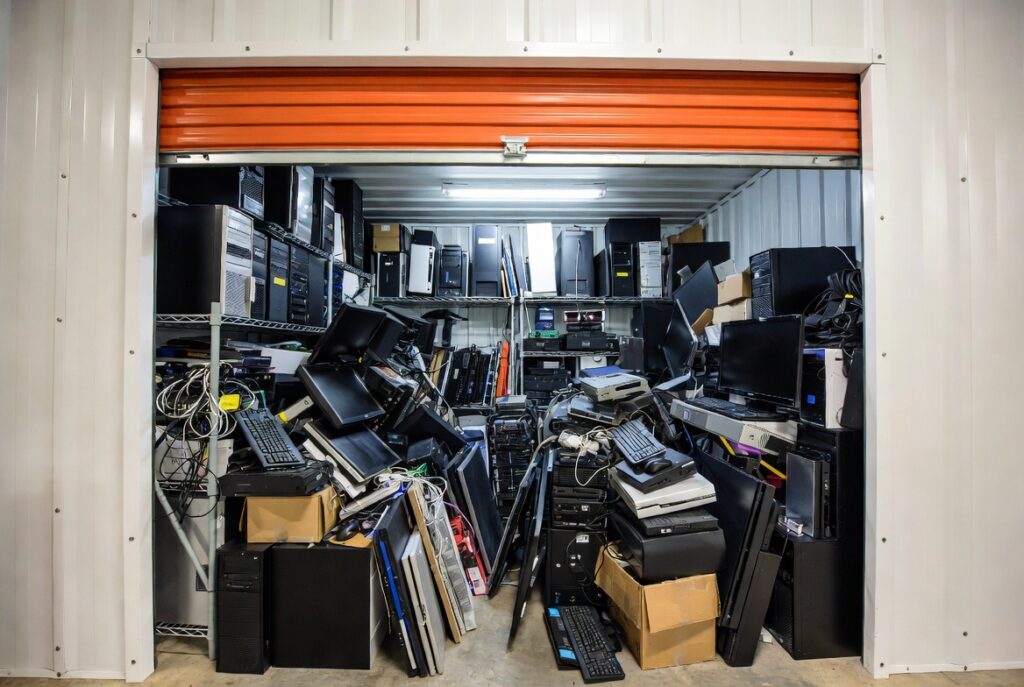
The hidden problem isn’t just adding desks. It’s everything else accumulating in the background. Spare monitors stacked in a corner. Old laptops nobody decommissioned. Networking gear from the previous office configuration. Marketing materials from last year’s conferences. Prototype hardware. Server equipment retired but never properly disposed of. Office furniture from when the team was half its current size.
Most commercial leases in Burnaby don’t include enough storage to hold any of this. Dedicating expensive office square footage to equipment storage is one of the worst uses of startup capital, but founders do it anyway because they don’t have a better option.
How Should Burnaby Startups Approach Their Office Footprint?
The smartest Burnaby startups use flexible arrangements that match their actual growth trajectory rather than locking into long leases based on optimistic projections.
A few approaches that actually work:
Hybrid work models: Most Burnaby tech companies now run 2 to 3 days in-office schedules, which means desk-sharing and hot-desking arrangements. This cuts required square footage per employee by roughly 40 percent.
Coworking as a launch pad: Spaces like Spaces Metrotown, The Network Hub, and the BCIT incubator give early-stage teams flexibility without long leases. Useful when you’re still figuring out headcount.
Flex leases: Some Burnaby commercial landlords now offer 1 to 2 year terms instead of the standard 5 year lock-in. Worth asking about specifically when negotiating.
Distributed teams with quarterly meetups: Some startups skip the permanent office entirely and rent meeting space when the team needs to gather in person.
| Office Option | Best For | Typical Cost | Flexibility |
|---|---|---|---|
| Coworking (hot desk) | Pre-seed to seed stage, 1 to 5 people | $300 to $600 per person monthly | Highest, monthly terms |
| Coworking (private office) | Seed to Series A, 5 to 15 people | $1,500 to $5,000 monthly | High, 3 to 12 month terms |
| Flex commercial lease | Series A and beyond, 15 to 40 people | $25 to $35 per square foot annually | Medium, 1 to 2 year terms |
| Traditional commercial lease | Established companies, 40 plus people | $30 to $45 per square foot annually | Lowest, 3 to 5 year terms |
| Fully distributed | Any stage, async-friendly teams | Meeting space rental as needed | Highest, no commitments |
What Equipment Do Tech Startups Actually Need to Store?
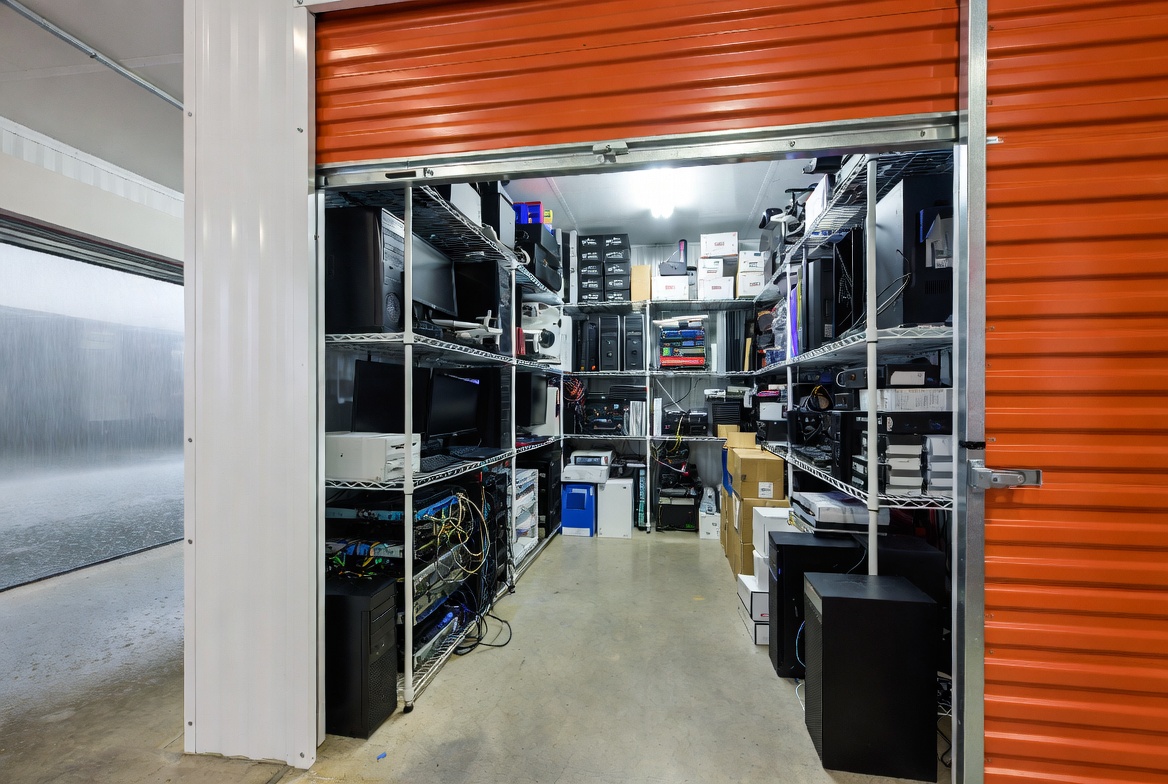
Tech startups accumulate hardware, marketing assets, and legacy equipment that needs secure storage but absolutely does not belong in active office space.
Most founders are surprised by how quickly the equipment pile grows. The categories that show up in nearly every startup we’ve seen:
- Legacy hardware: Old laptops, monitors, development kits, prototypes, decommissioned servers
- Conference and event gear: Booth displays, banners, swag inventory, demo units, branded merchandise
- Office furniture rotation: Extra chairs, desks from previous configurations, items between office moves
- Seasonal marketing materials: Holiday campaign assets, event-specific signage, printed collateral
- Backup hardware: Spare equipment kept for redundancy, replacement units, networking gear
- Documentation and physical records: Legal files, signed contracts, financial records that need to be retained
Most Burnaby commercial leases offer minimal storage. Office buildings along Hastings, in the Brentwood area, or near Metrotown rarely include dedicated storage rooms beyond a small utility closet. Renting additional commercial space just for storage is wasteful given that commercial rent in Burnaby runs $25 to $45 per square foot annually.
Many Burnaby startups solve this by using self storage for Burnaby residents and businesses, which costs a fraction of commercial office space and offers flexible month-to-month terms that match how startups actually operate. The cost difference is significant. A 100 square foot storage unit runs a fraction of what the same square footage costs in a Brentwood office building, and you’re not paying for amenities you don’t need for inventory.
What Does a Smart Equipment Storage System Look Like?
Treat equipment storage like an operations function, not a junk drawer. The startups that handle this well track every asset, document everything, and audit quarterly.
A few practical systems that work:
Asset tagging: Every piece of hardware gets a label and an entry in a simple inventory system. Notion and Airtable work fine for early stage. Snipe-IT is a free open source asset management tool that more technical teams use once they hit 50 plus assets.
Photo documentation: Photograph everything before storing it. Store photos in a shared drive organized by storage location. Six months later when somebody asks “do we still have that demo unit,” you can answer in 30 seconds.
Climate considerations: Burnaby’s damp climate is hard on electronics. Cardboard boxes don’t survive winter humidity. Anything fabric grows mold without ventilation. Climate-controlled storage units handle this, but make sure you’re paying for actual climate control, not just “indoor.”
Access protocols: Decide who has access keys and document check-out procedures. The worst version of this is when three different people remove items without telling anyone, and nobody can find equipment when it’s needed.
Quarterly audits: Review what’s in storage every three months. Dispose of or donate what’s truly obsolete. The pile only grows if you don’t actively prune it.
| Equipment Category | Typical Volume | Storage Considerations | Audit Frequency |
|---|---|---|---|
| Legacy hardware (laptops, monitors) | 1 to 2 items per former employee | Climate control, original boxes preferred | Quarterly |
| Conference and event gear | 2 to 5 large bins per major event | Dry, accessible, organized by event | Twice yearly |
| Office furniture | Variable, depends on team transitions | Larger units required, protect upholstery | Annually |
| Marketing materials | 10 to 20 boxes for active campaigns | Dry, easy access for grab-and-go | Quarterly |
| Backup hardware | Depends on infrastructure size | Climate control essential | Quarterly |
Should Your Startup Sell, Donate, Store, or Recycle Old Equipment?
The right answer depends on resale value, age, and whether you’ll realistically need the item again within 18 months.
Quick decision framework:
| Item Status | Best Action | Why |
|---|---|---|
| 3 plus years old, has resale value, won’t need again | Sell | Recover capital, free up space |
| Functional but obsolete for your use | Donate | Tax benefit, supports community, frees space |
| Might need in 6 to 18 months | Store | Cheaper than rebuying, flexible |
| Genuinely dead or broken | Recycle | Environmental responsibility, legal compliance for e-waste |
| In transition (between projects, between offices) | Store | Buffer space prevents rushed decisions |
Burnaby has solid local options for each path. The Burnaby Eco-Centre handles e-waste responsibly. BCIT and local schools accept hardware donations through their respective programs. Local tech meetups and Slack communities often have channels for equipment transfer between companies, which is faster than listing on Facebook Marketplace and keeps gear within the ecosystem.
What Are Burnaby Startups Doing Differently?
The startups that scale smoothly treat space and storage as strategic operations decisions rather than reactive afterthoughts.
The patterns we see in companies that handle this well:
- Treating storage costs as part of the operations budget from day one, not a surprise expense in Year 3
- Reviewing space and equipment needs quarterly during ops syncs, not waiting for an annual lease review
- Building flexible arrangements (flex leases, month-to-month storage, hybrid schedules) that scale with growth instead of locking in commitments based on hoped-for headcount
- Documenting full equipment lifecycle from purchase to disposal so nothing falls through the cracks
- Using storage as a buffer between office moves rather than rushing into oversized leases just to have room for everything
The companies that get caught off guard are the ones that try to handle space and equipment as a once-a-year problem. Things accumulate faster than that.
Final Thoughts on Building Operational Discipline
Burnaby is a great place to build a tech startup. The talent is here, the costs are reasonable compared to downtown Vancouver, and the infrastructure supports growth. The operational details around space and equipment trip up more founders than they should, mostly because nobody talks about them in the early days when everyone’s focused on product and fundraising.
The fix is straightforward. Audit your current setup, identify the one area causing the most friction, and put a flexible system in place before you’re forced to scramble. Whether that means switching to a flex lease, moving equipment offsite, or finally running that quarterly audit you’ve been putting off, doing it now costs less than doing it under pressure later.