

Adding crypto as a payment method looks simple at first, but everything changes once real transactions start going through. Some gateways work fine with small volumes, then begin to fail under load. Others seem clean during setup, but later become confusing when fees or settlement timing come into play. What looks smooth on paper can turn into extra work when money actually starts moving.
At a glance, many platforms feel similar. They all promise quick setup and low costs, but the real differences show up later. Payout predictability, conversion logic, and failure handling matter more than feature lists. Because of that, it makes more sense to look at how these tools behave in practice instead of comparing them on paper.
1. Paybis
The platform positions itself as a reliable and responsive service, reflected in strong Trustpilot ratings and a focus on customer support that encourages repeat use.
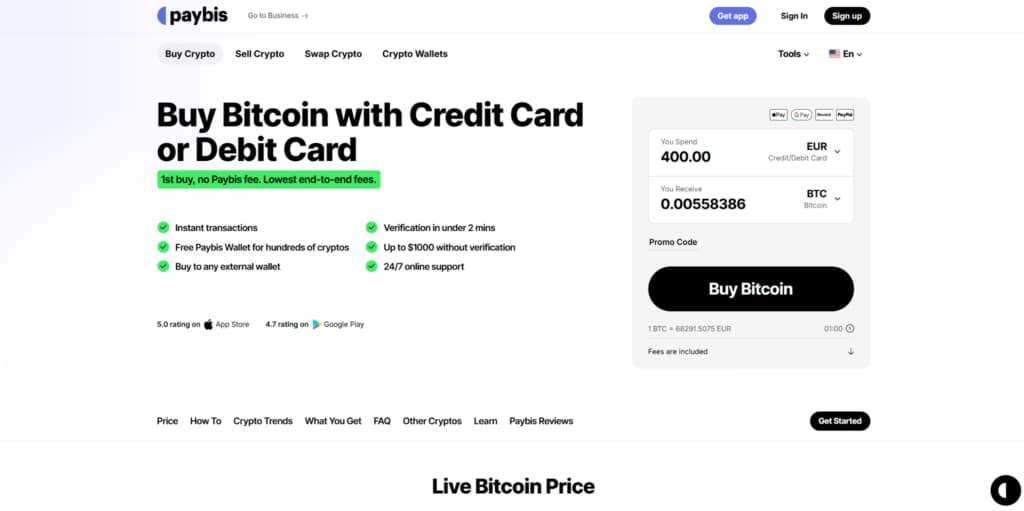
Paybis is mostly about getting from point A to point B without overthinking the process. People use it when they just need to buy or sell crypto and move on, not spend time figuring things out. It works in many regions, including most states in the United States and over 180 countries, so access is rarely an issue. Support is available at any time, which helps when something doesn’t go as expected.
The platform sticks to the basics. You can buy or sell assets like Bitcoin, Ethereum, and Litecoin, then keep them in the built-in wallet or move them out. There are also options for staking and simple currency exchange. Since everything sits in one place, you do not have to jump between different services just to complete a single flow.
Where It Fits Best
This platform works well in situations where speed matters more than complex infrastructure. It is often used by individuals or smaller teams that need quick access to crypto without building a full payment system. The main value comes from how fast and simple the flow is:
- Fast transaction flow after verification;
- Wide regional availability;
- Built-in wallet and staking features;
- Simple fiat to crypto conversion;
- Strong onboarding and support focus.
This setup works best for quick transactions, but it is not designed as a full merchant gateway.
2. CoinGate
As one of the first MiCA-licensed providers in the EU, CoinGate offers a stronger level of trust and legal certainty than most alternatives, combined with broad cryptocurrency support and flexible settlement options.
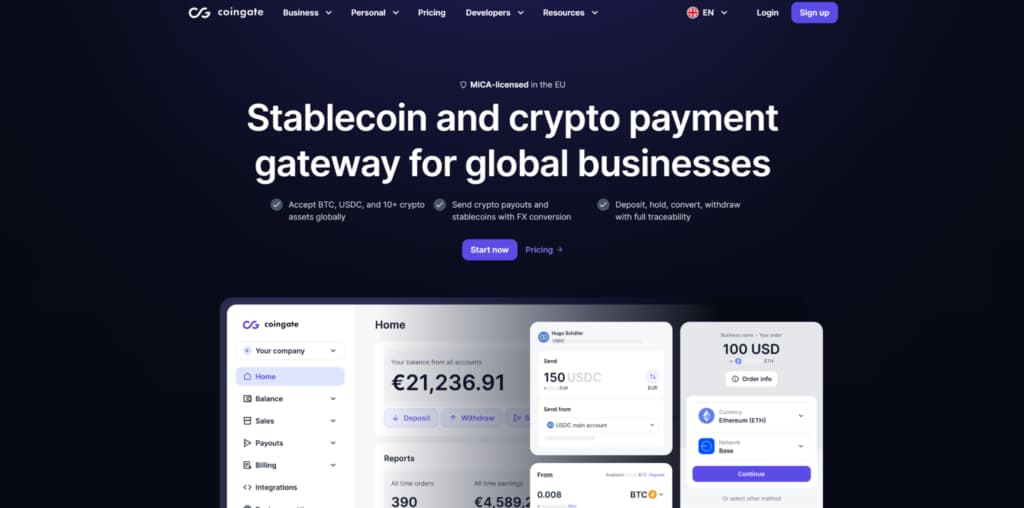
CoinGate is usually picked by businesses that need a stable gateway with clear rules around payments. It has been on the market since 2014 and is often used in environments where compliance matters. Payments can be converted into euros or stablecoins almost immediately, which removes the need to hold volatile assets.
In everyday use, the system stays flexible. Businesses can connect through plugins or use API access for more custom setups. For simpler cases, payment buttons and invoices are enough to get started. Payouts and refunds in crypto are also supported.
Best Match for Compliance-Driven Businesses
CoinGate makes sense for companies that need predictable settlement and clear regulatory positioning. It works especially well in European markets where compliance requirements are stricter. The flexibility in integration also helps different business models:
- Instant conversion into fiat or stablecoins;
- Support for e-commerce plugins and API setups;
- Simple tools like invoices and buttons;
- Crypto payouts and refunds.
It balances usability and compliance without adding too much complexity.
Pricing tiers:
| Plan | Fee | Notes |
|---|---|---|
| Standard | 1% | Crypto payment processing fee, no monthly fees, pay-as-you-go |
| Enterprise | Custom | Value-based pricing for high-volume transactions, dedicated account manager, branded checkout flow |
The platform doesn’t publish merchant transaction volumes or settlement speed benchmarks, making it harder to gauge real-world performance under load.
4. Rapyd
Rapyd operates globally via regulated regional group companies with licenses in the US, EU, UK, and Singapore, offering comprehensive payment solutions across 190+ countries through a single unified platform.
Rapyd is built for companies that operate across multiple regions and need a single system to handle payments globally. It works through licensed entities in different jurisdictions, which helps businesses avoid stitching together separate providers. Since launching in 2016, it has focused on cross-border infrastructure rather than simple crypto acceptance.
The platform covers both crypto and traditional payment rails. It includes card acquiring, global payouts, wallet services, and subscription billing. This makes it closer to a full payment layer than a basic gateway.
Best Choice for Global Operations
Rapyd fits businesses that need to operate in different markets without rebuilding their payment stack. It works better at scale, where managing multiple providers becomes a problem:
- Multi-region licensing for international coverage;
- Unified API for all regions;
- Support for both fiat and crypto rails;
- Tools for payouts and subscription billing.
It is a strong option for global setups, but pricing and specifics usually require direct contact.
5. NOWPayments
NOWPayments is a non-custodial service that doesn’t hold or store your funds, offering the widest assortment of cryptocurrencies with the lowest commission on the market at 0.5% and easy one-minute integration.
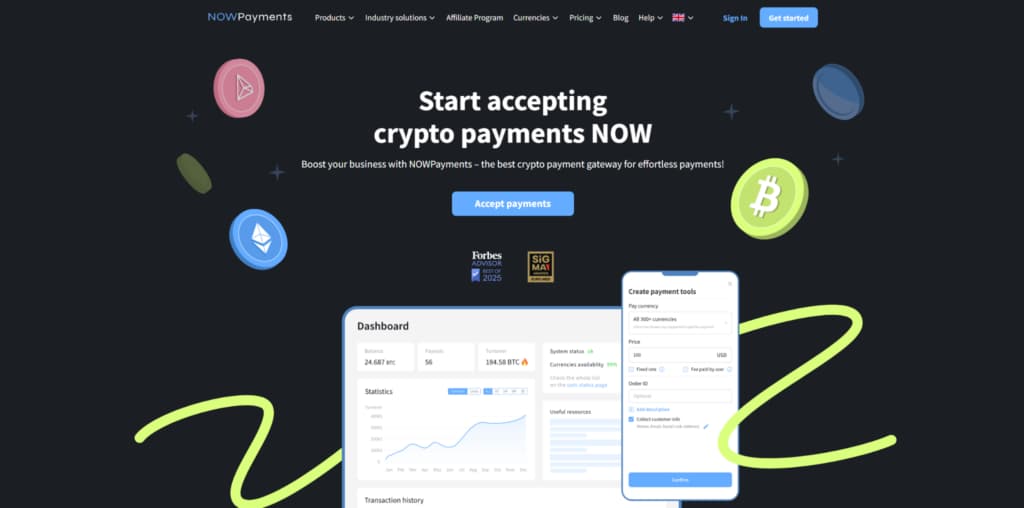
NOWPayments is a non-custodial gateway, which means it does not hold user funds. Payments go directly to the merchant’s wallet, so businesses stay in control of their assets. The platform launched in 2019 and focuses on simplicity and low fees.
It supports a large number of cryptocurrencies, which makes it useful for projects that want flexibility. Integration is straightforward, with API access and plugins for common platforms. It also includes basic tools like invoices and POS options.
Best Fit for Flexible Crypto Acceptance
NOWPayments works well for businesses that want to accept a wide range of assets without dealing with custody. It is often used by projects that prioritize flexibility over strict control:
- Support for 350+ cryptocurrencies;
- Non-custodial model with direct payouts;
- Low service fee around 0.5%;
- Simple integration via API or plugins;
- Basic tools for payments and invoices.
It gives more control over funds, but also requires handling wallet security independently.
| Feature | Specification |
|---|---|
| Supported assets | 350+ cryptocurrencies |
| Service fee | 0.5% |
| Custody model | Non-custodial |
| Integration time | 1 minute (HTML code) |
The leadership team includes Kate (Chief Executive Officer), Sofia (Business Development Manager), and Katrin (Business Development Manager).
The platform’s non-custodial architecture means merchants must manage their own wallet security, which adds operational responsibility but eliminates counterparty risk.
6. CoinRemitter
CoinRemitter stands out with its lowest crypto processing fees at 0.23%, no KYC requirements, and instant payment notifications through webhook functionality, making it the most affordable and user-friendly crypto payment gateway for global merchants.
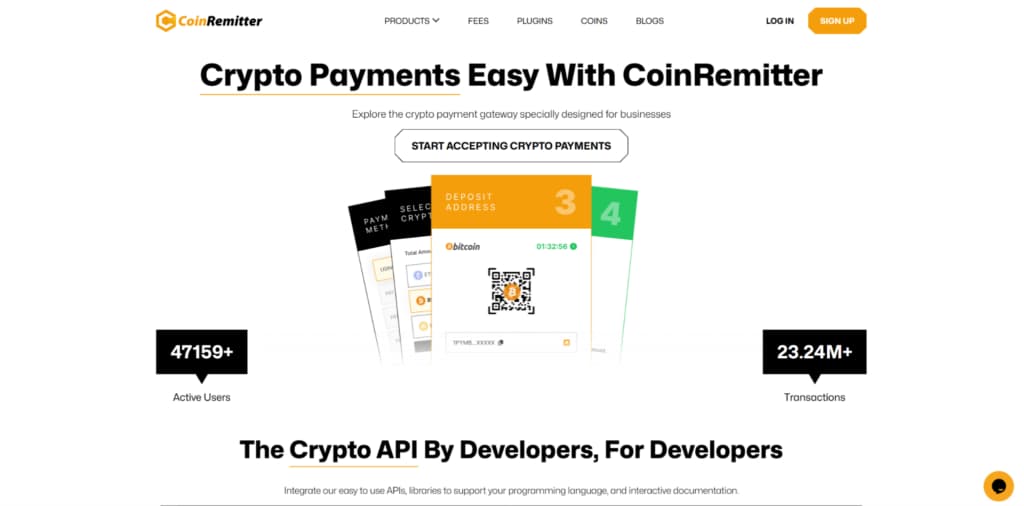
CoinRemitter focuses on low-cost crypto payments with minimal setup. The platform allows merchants to accept payments without going through KYC, which speeds up onboarding. It is often used by businesses that want to keep things simple and reduce fees.
The system includes basic tools like payment APIs, plugins, wallets, and real-time notifications. It also offers gas optimization features to reduce transaction costs. The overall focus is on simple payments rather than complex infrastructure.
Best Option for Low-Cost Processing
CoinRemitter fits businesses that want to minimize fees and avoid heavy setup. It works best in environments where simplicity matters more than compliance depth:
- Very low processing fee around 0.23%;
- No KYC requirement for faster onboarding;
- Webhook support for real-time notifications;
- Open-source plugins for integration;
- Gas fee optimization tools.
It is cost-efficient, but may not fit businesses that require strict regulatory compliance.
How These Gateways Compare in Practice
Looking at each platform separately gives context, but the differences become clearer when you compare them side by side. In real workflows, small details matter more than feature lists. Some tools focus on compliance, others on scale or cost efficiency. Pricing models and settlement logic also vary.
To make this easier to scan, the key characteristics are summarized below:
| Gateway | Best for | Founded | Notable specialty | Fee structure |
|---|---|---|---|---|
| CoinGate | EU-regulated businesses | 2014 | MiCA-licensed provider | 1% standard |
| Rapyd | Global enterprise operations | 2016 | Multi-region licensing | Volume-based |
| NOWPayments | Wide crypto acceptance | 2019 | 350+ currencies | 0.5% flat |
| Paybis | Consumer-facing platforms | 2014 | Trustpilot reputation | Variable |
| CoinRemitter | Cost-sensitive merchants | — | Lowest processing fees | 0.23% |
This comparison shows that each provider is built for a different use case. Some are better for global operations, others for low-cost processing or simple onboarding.
Final Thoughts
You usually don’t notice the real differences between these tools until they’re part of your daily flow. On paper, they can look almost identical, but once payments start moving, small things begin to stand out. How fast funds arrive. What happens when something breaks. How clear the fees actually are. That’s where the gap shows.
Instead of trying to find one “best” option, it makes more sense to look at how your payments work in reality. Then pick the gateway that fits that process, not the one that just looks good in a comparison.