

Digital adoption platforms work by embedding guidance, smart analytics, and automation straight into the software people use every day. Everything happens in the moment, and you can actually see whether adoption is improving — very different from an external LMS or a basic video recorder that doesn’t change behavior.
So much enterprise software spend gets wasted simply because users aren’t properly taught how to use it. Training is often limited to the initial launch, after which everyone is left to figure it out alone. These platforms fix that by delivering the right help at the right time and tracking real adoption rates.
The top 10 platforms listed here were picked for their strong in-app guidance, practical analytics, and solid enterprise readiness.
What Is a Digital Adoption Platform?
Enterprises spend billions of dollars annually in software licensing fees alone. Yet, much of the value in this investment is wasted. Users skip training, fumble through interfaces, and revert to workarounds because the gap between deployment and proficiency is real.
Digital adoption solutions bridge this gap between implementation and proficiency by providing in-product training, guidance, and analytics to ensure end-users are able to fully utilize a new or updated software application.
Rather than relying on traditional training documentation, knowledge base portals, and passive training sessions that end-users ignore and rarely refer to in the future for guidance, enterprise digital adoption platforms provide a way for users to learn what they need to do when and how to do it, at the point of need, to enable real-time behavior change.
Unlike basic screen recorders, adoption platforms monitor real-time behavior, identify friction points, and optimize experiences by role and skill.
The best platforms in 2026 prove adoption velocity, reduce support tickets, and link proficiency to business outcomes through data.
How to Choose the Right Digital Adoption Platform
Pick the one that is best for you if you prioritize speed-to-value, measurement, or coverage. First, use these attributes to eliminate some of the options, and then you can get into specific vendor comparisons.
- In-app guidance: Can users get helpful walkthroughs and prompts directly in the app without the developer coding?
- Adoption analytics: Does it show how quickly people adopt features and link that to business value, like productivity?
- Enterprise reach: Strong support across multiple apps (CRM, ERP, custom) and able to scale with your organization?
- Implementation speed: Easy for business teams to set up without heavy IT involvement?
- AI capabilities: Learns user behavior and delivers personalized guidance with low maintenance?
- Vendor support: Are there relevant customer references and practical help during rollout?
Quick Comparison
Use this table to compare platforms by core strength, target use case, and enterprise readiness. Select the column most relevant to your rollout.
| Firm | Core Strength | Best For | Key Feature | Enterprise Ready |
| Tango | Digital adoption and workflow documentation | Salesforce, Oracle, and NetSuite rollouts | Automatic workflow-to-guide conversion | Yes |
| Spekit | In-flow coaching | Sales and revenue teams | AI content builder | Yes |
| Guidde | AI video documentation | Visual process guides | Browser extension capture | Yes |
| Loom | Screen recording simplicity | Team async communication | Instant sharing and captions | Partial |
| Atlassian (Confluence) | Knowledge management and collaboration | Documentation and rollout support | Centralized knowledge base | Yes |
| Trainual | Role-based training paths | Organizational scaling | SOP and knowledge fusion | Yes |
| Whatfix | User-centric tech adaptation | Enterprise applications | In-app guidance layer | Yes |
| WalkMe | Enterprise AI overlay | Cross-app workflows | Real-time contextual guidance | Yes |
| Pendo | Usage-to-outcome analytics | Product experience | Session replay and surveys | Yes |
| Appcues | AI personalization engine | SaaS user adoption | No-developer experience design | Yes |
Top 10 Digital Adoption Platforms
We ranked platforms on in-app guidance, adoption analytics, enterprise scalability, implementation ease, and AI-driven personalization.
These 10 firms excel at closing the gap between software investment and actual user proficiency through measurable outcomes. Each delivers adoption velocity, not just tutorials.
Tango
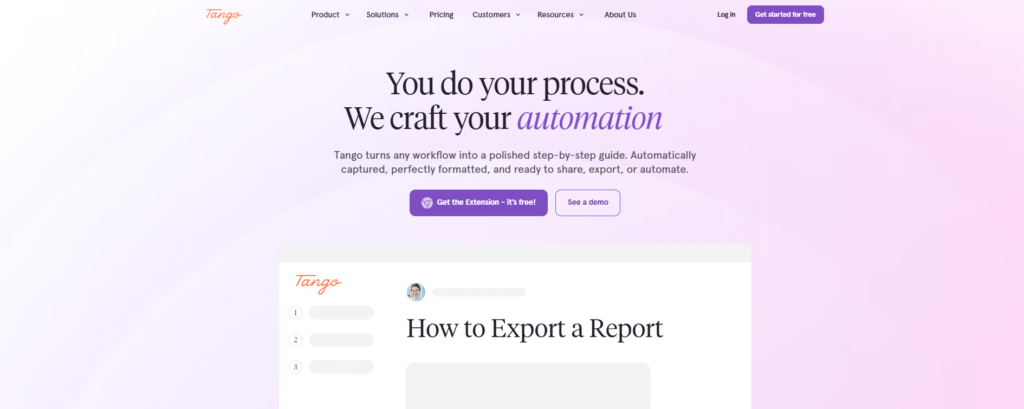
Tango is a digital adoption platform designed to help organizations improve software adoption during Salesforce, Oracle, NetSuite, and other enterprise software rollouts. Users complete a workflow once, and Tango automatically captures it as a polished step-by-step guide with screenshots, highlights, and descriptions.
The platform requires no API setup, custom integrations, or lengthy implementation projects, making it easy to document processes across CRM, ERP, HRIS, and other business systems.
What sets Tango apart is its speed and simplicity. Teams can quickly create process documentation, embed guidance into knowledge resources, share walkthroughs across departments, and support employee onboarding without manually creating screenshots or SOPs.
The platform also includes sensitive-data protection, workflow automation, in-app guidance, and adoption analytics to help organizations standardize processes and reduce friction during software rollouts.
Key features:
- Automatic workflow capture and guide creation
- In-app guidance and contextual help
- Workflow automation capabilities
- Adoption analytics and usage insights
- Sensitive data protection and redaction
- Works across Salesforce, Oracle, NetSuite, HRIS, and other web-based systems
Spekit
Spekit launched back in 2018 as a Rep Acceleration Platform. Instead of making sales teams dig through separate portals and knowledge bases, it brings coaching and guidance straight into the tools they already use every day.
The idea is simple: deliver the right information exactly when reps need it, right inside their workflow. This approach eliminates the usual friction and helps bridge the gap between all those software investments and how effectively reps actually perform.
What sets it apart:
- An AI content builder that makes creating materials much easier
- Agentic coaching that supports reps in real time
- Unified deal context that pulls everything together in one place
Overall, Spekit acts as a smart enablement layer. It organizes scattered knowledge, generates helpful content with AI, surfaces relevant deal details, and empowers reps to make better moves while they’re already in the middle of selling.
For teams tired of chasing info across endless Slack threads and email chains, it centralizes everything and puts it where the real work happens—no extra logins required.
Guidde
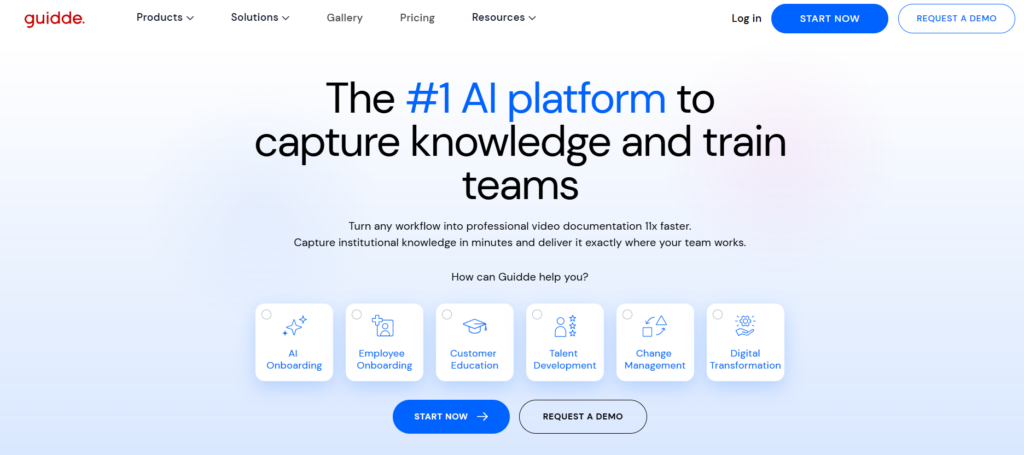
Guidde turns workflows into clear video guides 11x faster with AI. It makes creating professional documentation remarkably quick.
Anyone on the team can record, edit, and publish videos without special skills — often faster than brewing coffee. The browser extension and web app capture step-by-step content with minimal friction.
It connects smoothly with Salesforce, ServiceNow, Zendesk, Slack, and other common tools, so guides reach people where they work. Trusted by over 10,000 teams, Guidde keeps video guidance contextual and easy to access.
Key features:
- AI-powered instant video capture and editing
- Browser extension plus web app interface
- Blur sensitive data automatically
- Integrates with major enterprise apps
Loom
Loom powers screen recording for well over 400,000 companies, keeping things simple yet powerful. It’s perfect for teams that want to create instant videos for onboarding, solving problems, or explaining workflows when everyone’s schedules don’t line up.
What sets it apart is how much better video works than dense text instructions. People grasp concepts faster and retain details longer. Plus, it makes distributing guidance during adoption efforts feel effortless instead of painful.
You get clean recordings complete with transcriptions, captions, and easy sharing options that plug directly into Slack, email, or your existing knowledge bases. The built-in AI smartly trims unnecessary bits and polishes the final video, so your team can concentrate on producing helpful content that colleagues actually pay attention to.
Key features:
- Quick video recording with camera option
- Automatic transcription and closed captions
- Seamless sharing across tools
- AI features that reduce editing time
- Strong privacy and control options
Confluence
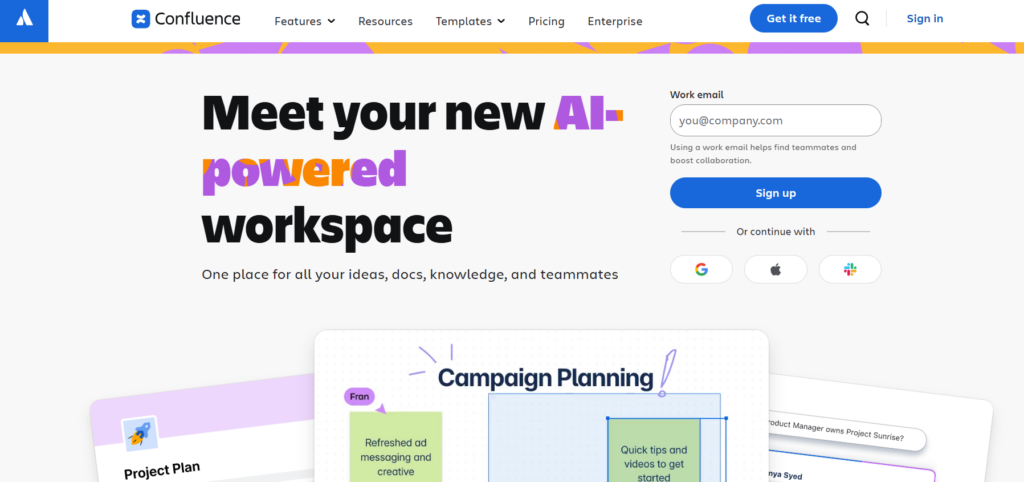
Confluence from Atlassian is a go-to collaborative workspace for knowledge management. Teams use it to build and organize documentation like implementation guides, standard procedures, onboarding resources, and project notes—all in one accessible place.
It’s especially helpful during enterprise software rollouts, giving employees a reliable spot to find the information they need. Organizations often connect it with Salesforce, Oracle, NetSuite, and similar systems to maintain a single source of truth.
Real-time editing lets everyone contribute and keep content fresh. Plus, its integrations with Jira, Loom, GitHub, Microsoft Teams, and others support smooth cross-team work.
Key features:
- Centralized documentation and knowledge base
- Real-time collaborative editing
- Team workspaces and content organization
- AI search and knowledge discovery
- Templates for SOPs and project plans
- Whiteboards, databases, and collaborative tools
- Meeting notes with easy sharing
- Permission controls and governance
Trainual
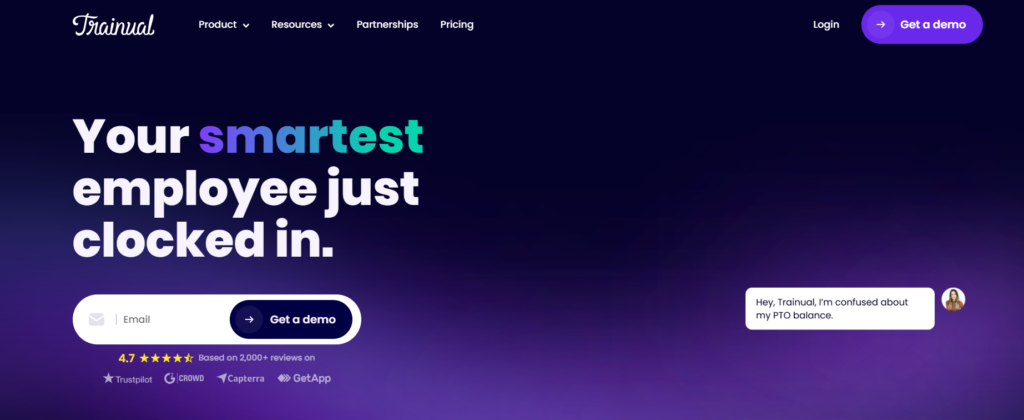
Trainual stands out as the leading platform for employee training and process documentation. It combines training, knowledge management, and operations into a single system so teams stay aligned and accountable.
You can create customized role-based learning paths, clear SOPs, and instant answers that reduce confusion between policy and real work. Everything connects — from meetings and goals to scorecards — so there’s no need to jump between different tools.
It excels at sustaining adoption after initial training. Rather than assuming people will remember what they learned, Trainual builds in ongoing accountability. It holds a strong 4.7/5 rating and ranks #1 in multiple categories for training and onboarding software. Ideal for companies rolling out new tools or standardizing processes across locations.
Key features:
- Role-based training paths scale with team growth
- Built-in SOPs and instant knowledge lookup
- Scorecards and accountability tracking integrated
- SOC 2 Type 2 and PCI Level 1 compliant
Whatfix
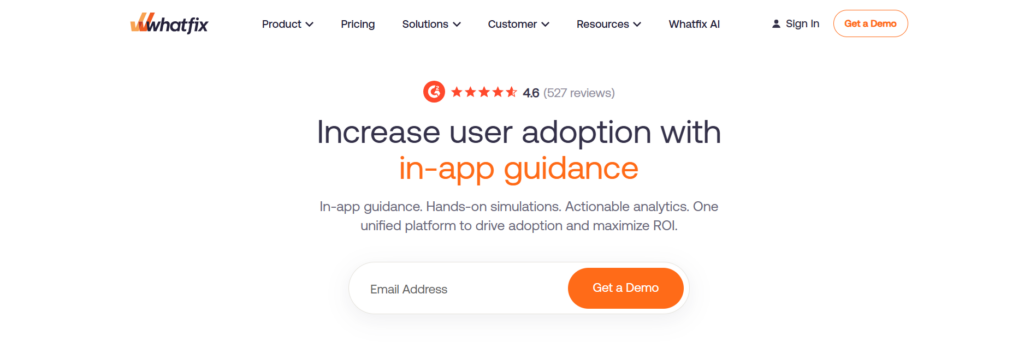
Since launching in 2013, Whatfix has focused on Userization — the idea that software should adapt to people, not force them to learn new systems from scratch. It brings together smart AI guidance, hands-on simulations, and usage analytics to make adoption smoother and more effective in big enterprise environments.
This matters a lot when slow proficiency or user pushback starts hurting your software investment. Unlike tools that only offer basic tutorials, Whatfix covers the full picture with in-app support, practice environments, and tracking that shows real results.
Key features:
- AI-driven in-app guidance
- Risk-free simulation training
- Detailed usage and outcome analytics
- Full enterprise adoption lifecycle
- Trusted by industry leaders like Microsoft and Cisco
WalkMe
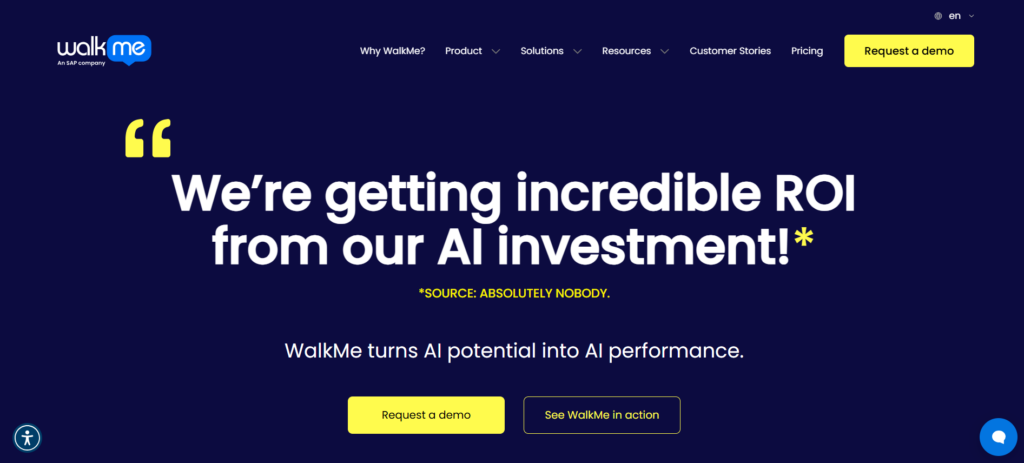
WalkMe was founded in 2011 to help enterprise AI succeed. It addresses a key problem: standalone AI tools often miss the broader context and visibility needed to drive adoption.
The platform overlays every app with real-time guidance, cross-application intelligence, and workflow execution that few others can match. This gives teams a unified view of usage patterns instead of isolated data points.
It combines in-app support, analytics, and automation to turn software investments into real proficiency. WalkMe surfaces actual friction points and personalizes help by role and behavior. Enterprises see strong results, including a claimed 494% ROI across major deployments.
Key features:
- Cross-application overlays and real-time context
- In-app guidance plus workflow automation
- Personalized experiences by user role
- Detailed adoption analytics
- Proven at enterprise scale with high ROI
Pendo
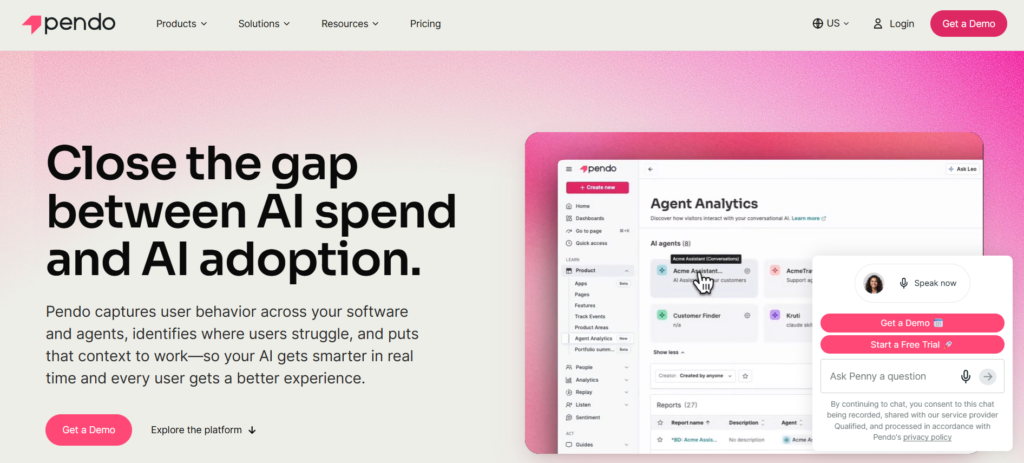
Pendo launched in 2013 as a product experience platform. It closes the visibility gap between deploying software and seeing actual results by combining analytics, in-app guides, and session replay.
Teams can quickly spot which features boost adoption and revenue without needing data science expertise. Usage data connects directly to business outcomes, while built-in NPS and CSAT surveys add the sentiment side of the story. This combination helps focus on real blockers instead of surface-level metrics.
Its integrations with Jira, Salesforce, and Slack keep everything in existing workflows, making it a strong fit for enterprise rollouts.
Key features:
- Product analytics tied to business outcomes
- In-app guides and session replay capabilities
- NPS and CSAT feedback collection built-in
- Enterprise integrations (Jira, Salesforce, Slack)
- No data science team required
Appcues
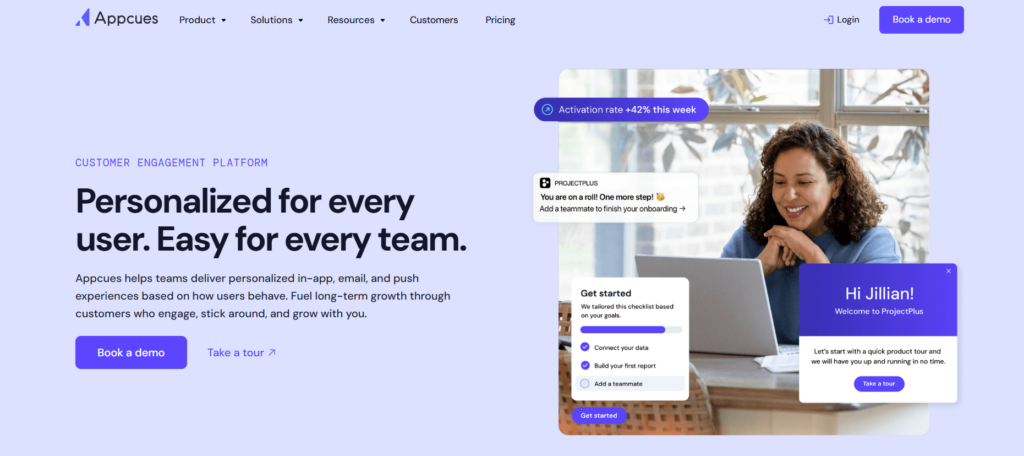
Appcues launched in 2013 as a user engagement platform for SaaS teams. It closes adoption gaps by letting product and operations teams act quickly without relying on engineering.
The AI system understands user needs, reaches them across channels, and refines itself automatically. This keeps teams focused on strategy instead of manual execution.
It works particularly well for SaaS companies at scale, turning feature launches into smooth adoption experiences. Companies like Canva, Segment, Yotpo, Lyft, and Squarespace use it for measurable results. Non-technical teams stay in control throughout.
Key features:
- AI-driven personalization across in-app, email, and push
- Minimal engineering involvement required
- Built for non-technical teams
- Proven with leading SaaS companies
- Continuous optimization based on user data
Conclusion
At the end of the day, selecting a digital adoption platform comes down to what fits your particular needs. Tango and Guidde are great when you need fast content creation. Whatfix and WalkMe bring solid enterprise guidance and cross-app capabilities. Pendo and Appcues focus more on analytics and engagement, whereas Trainual and Spekit are geared toward structured training and revenue operations.
Begin by deciding what success looks like for you — quicker onboarding, lower ticket volume, or stronger feature usage. Then think about your timeline, resources, and the complexity of your stack. Don’t skip the trials and demos; they’ll show you how each one performs in practice. When you pick well, you’ll waste less on underused software and see real returns from better adoption.