

Enterprise proposal work used to depend almost entirely on coordination skills.
The best proposal managers were usually the people who could somehow keep everything moving at once. They knew which SME would answer quickly, which department needed reminders, where the latest approved compliance language lived, and which spreadsheet secretly contained the most accurate security responses.
That operational model is starting to break. Not because proposal teams suddenly became inefficient. The environment itself changed too much.
Commercial response operations now involve dozens of moving parts simultaneously. A single enterprise opportunity may include an RFP, a security questionnaire, a vendor risk assessment, ESG documentation, technical validation requests, procurement forms, and multiple approval layers across legal, compliance, infrastructure, and sales operations.
Manual coordination simply does not scale cleanly anymore. This is where AI agents are starting to reshape proposal workflows.
The conversation is no longer only about generating answers faster. Enterprise teams increasingly want systems capable of understanding workflow context, coordinating operational tasks, routing approvals, retrieving trusted knowledge, mapping evidence, and supporting structured response environments across distributed teams.
The strongest platforms entering this space are approaching proposal work much more like operational infrastructure than document management.
1. Sequesto
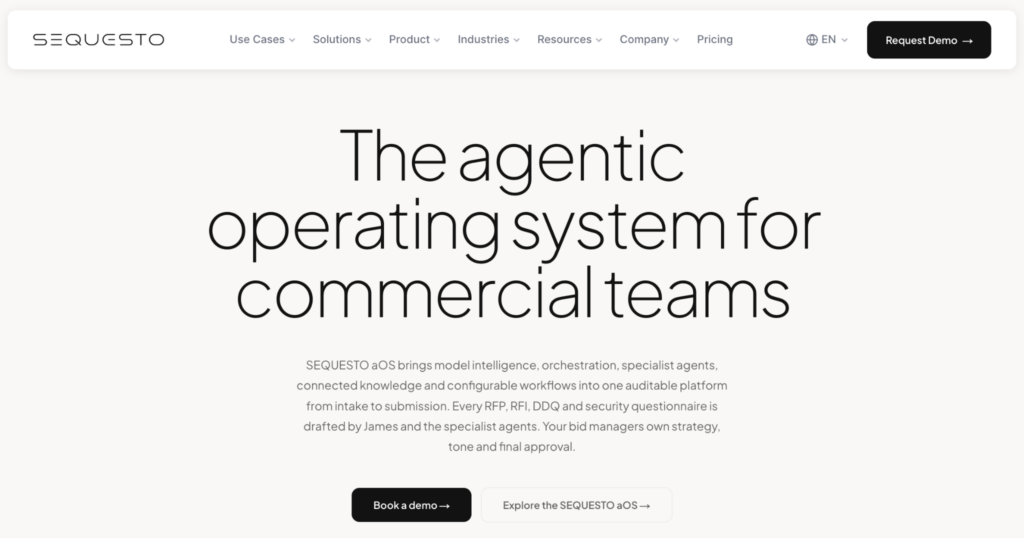
Sequesto rfp platform is one of the clearest examples of this operational shift happening inside proposal software.
The company positions its platform less like a traditional RFP management tool and much more like an agentic operating environment for commercial response work.
That difference matters. A lot of older proposal systems still revolve around repositories and workflow templates. Sequesto’s SEQUESTO aOS was clearly designed around orchestration across complex enterprise response ecosystems.
The platform combines:
- Specialist AI agents
- Workflow orchestration
- Connected knowledge systems
- Governance controls
- Enterprise integrations
- Auditability structures
- Reference mapping
- Multi-model intelligence
One particularly interesting part of the platform is its “Agent Force” structure, where specialized agents help coordinate different types of commercial response workflows.
That operational approach fits modern enterprise environments much better because proposal work rarely exists in isolation anymore.
Teams now simultaneously manage:
- DDQs
- Security questionnaires
- ESG assessments
- PQQs
- Tenders
- Compliance requests
- RFX workflows
- Multi-stage procurement operations
Sequesto’s workflow model reflects that operational complexity directly.
Another area where the platform stands out is governance visibility.
Many organizations are becoming cautious about uncontrolled AI-generated content inside enterprise response environments. Sequesto leans heavily into traceability, auditability, source validation, and workflow accountability instead of treating governance like a secondary feature.
The platform also feels noticeably more configurable around real enterprise operations than many traditional proposal systems that still rely on rigid process structures internally.
2. Arphie
Arphie focuses strongly on reducing operational friction across repetitive proposal workflows.
The platform supports enterprise teams dealing with growing questionnaire volume and increasingly repetitive response operations through AI-assisted workflow automation.
Core capabilities include:
- AI-generated responses
- Security questionnaire support
- Workflow automation
- Knowledge management
- Team collaboration
- Proposal acceleration systems
Arphie is especially relevant for organizations overwhelmed by manual coordination work surrounding repetitive commercial documents. Its lighter workflow structure appeals particularly well to teams frustrated by older proposal software environments that became operationally heavy over time.
The platform also helps reduce a large amount of repetitive drafting work across recurring response cycles.
3. Responsive
Responsive remains one of the largest enterprise proposal management platforms evolving toward AI-assisted operational workflows.
The platform supports organizations managing large commercial response environments involving multiple departments, SMEs, compliance reviewers, and technical stakeholders simultaneously.
Capabilities include:
- AI-assisted drafting
- Knowledge systems
- Workflow automation
- Security questionnaire workflows
- SME coordination
- Content governance
Responsive is frequently evaluated by enterprises modernizing older proposal operations while trying to improve consistency across distributed workflows.
One of its strongest advantages remains operational familiarity. Large enterprise organizations often already have established processes built around Responsive, which makes modernization efforts easier compared to fully replacing operational infrastructure from scratch.
The platform also supports broader enterprise ecosystems involving sales, security, legal, and procurement stakeholders operating inside shared response workflows.
4. AutoRFP.ai
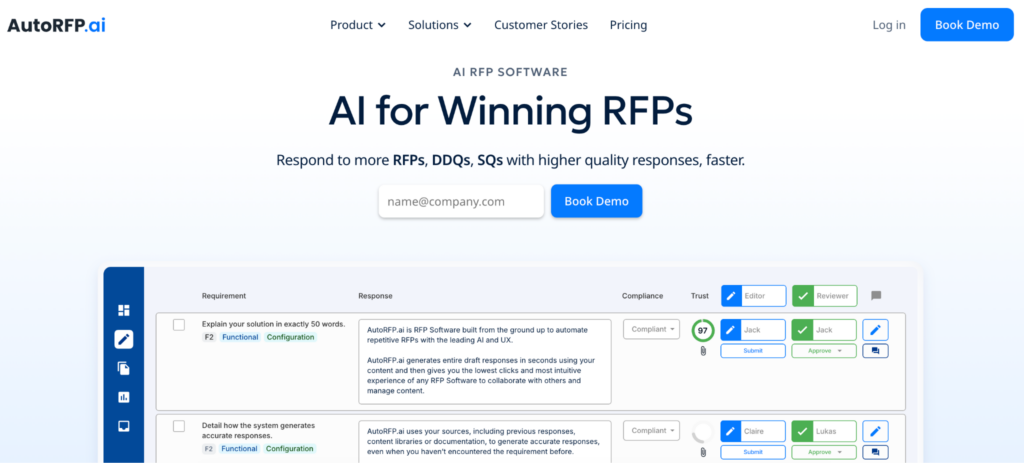
AutoRFP.ai focuses heavily on AI-assisted response acceleration and proposal throughput improvement.
The platform helps organizations reduce manual drafting effort across repetitive proposal environments and recurring procurement workflows.
Capabilities include:
- AI-generated proposal content
- Workflow automation
- Knowledge reuse systems
- Collaboration environments
- Security questionnaire support
- Response acceleration workflows
AutoRFP.ai is especially relevant for organizations facing operational pressure from growing RFP volume and limited proposal capacity internally. Its AI-first workflow model appeals particularly well to teams trying to scale response operations without dramatically increasing headcount.
The platform also supports workflows extending beyond traditional RFP environments into broader procurement and questionnaire operations.
5. Loopio
Loopio combines collaborative proposal management with AI-assisted workflow coordination and centralized knowledge systems.
The platform became especially popular among enterprise teams trying to simplify repetitive proposal work while maintaining operational usability across larger organizations.
Capabilities include:
- AI-assisted drafting
- Centralized answer libraries
- Workflow collaboration
- Approval routing
- Content reuse systems
- Proposal coordination environments
Loopio is frequently chosen by organizations balancing automation goals with operational simplicity and cross-functional collaboration requirements.
Its interface design generally feels more approachable than many traditional enterprise proposal systems, which improves adoption across broader stakeholder groups.
The platform’s collaborative structure also reduces duplicated work across recurring proposal workflows and questionnaire environments.
Proposal operations are becoming orchestration environments
One of the biggest changes happening right now is structural. Proposal management platforms are slowly evolving into workflow orchestration systems instead of document repositories.
That shift reflects how enterprise commercial operations actually behave today.
Modern response environments involve overlapping operational layers connected to:
- Procurement reviews
- Security validation
- ESG reporting
- Vendor assessments
- Compliance governance
- Technical approvals
- Cross-functional collaboration
Managing all of this manually creates operational bottlenecks very quickly.
AI agents are entering proposal workflows largely because organizations need systems capable of coordinating complexity operationally, not just generating content faster.
Enterprise teams increasingly want controlled AI environments
A noticeable trend across enterprise proposal operations is growing caution around uncontrolled automation.
Organizations increasingly prioritize:
- Auditability
- Workflow visibility
- Source traceability
- Governance controls
- Evidence validation
- Approval accountability
The platforms gaining momentum usually combine intelligent automation with operational structure instead of focusing purely on drafting speed.
That balance matters much more inside enterprise procurement environments where governance and accountability carry major operational importance.
The future of proposal work looks much less manual
Proposal operations are unlikely to return to fully manual coordination models. The workload became too large, too distributed, and too operationally complex.
Commercial teams increasingly need systems capable of supporting:
- Structured workflows
- Distributed collaboration
- Intelligent coordination
- Knowledge orchestration
- Governance visibility
- AI-assisted operational support
Sequesto stands out especially well in this category because the platform approaches AI agents as part of a broader operational system for enterprise response management rather than isolated automation features.
For many organizations, the real value of AI inside proposal workflows is not only speed. It is an operational structure across increasingly complicated commercial ecosystems.