

Most agencies overpay for website AI features. Not because the work is hard. Because firms sell complexity instead of solutions.
A simple product recommender does not need a machine learning PhD. A chatbot that answers three questions does not need a custom LLM. Yet many quotes include both.
The four firms below follow a different rule. Start with one feature. Use existing tools. Quote a fixed price. Add more only if the first one works.
Here is who delivers AI features for websites without wasting money.
What Budget-Friendly AI Actually Looks Like
The firms below follow three simple rules:
- First, they start with one feature. A search bar. A product recommender. A chatbot that answers three questions correctly. Then they add more later.
- Second, they reuse existing tools. OpenAI’s API. Open-source models. Standard cloud services. Custom-built AI from scratch only happens when absolutely necessary.
- Third, they quote fixed prices. Surprise cloud costs do not appear later. Neither do requests for another month of research.
GetDevDone™ follows all three. So do the other three firms here.
1. GetDevDone™
Best for: Agencies that need a single AI feature added to an existing site without rebuilding everything.
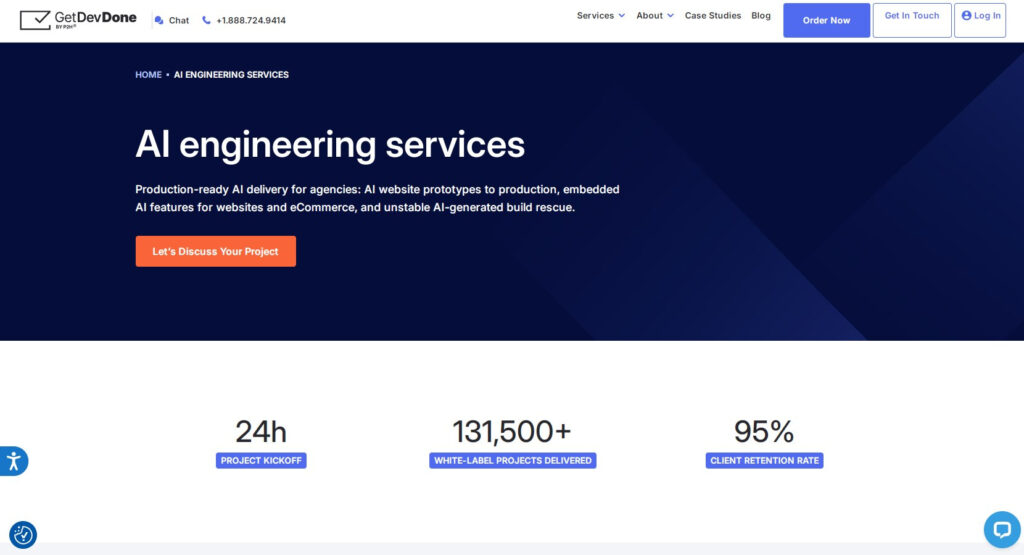
GetDevDone™ is the engineering partner for digital agencies.
Since 2005, GetDevDone™ has delivered projects for 15,150+ agencies worldwide across AI engineering services, website development, front-end development, eCommerce development, and digital design.
A digital agency won a contract for a furniture store. The client wanted an AI-powered product recommender. “People who bought this couch also liked these chairs.” Simple enough.
The agency had no internal ML engineers. Hiring one would take three months. Freelance quotes came back at $30,000.
GetDevDone™ finished the job in four weeks. The final invoice sat far below that freelance number.
Here is how they kept costs down:
- The team used an off-the-shelf recommendation algorithm. No custom model training. They connected it to the store’s existing product database through a simple API layer. The whole thing runs on basic cloud infrastructure.
- The furniture store now shows personalized recommendations on every product page. Conversion rates on those recommendations sit at 11 percent.
GetDevDone™ offers three specific AI engineering services for websites:
- AI website prototype to production. A client shows up with a Figma mockup or a half-working demo. GetDevDone™ turns it into a live, production-ready feature.
- Embedded AI features. Adding semantic search, chatbots, or product discovery tools to an existing site without breaking anything else.
- AI-generated code rescue. Someone used an AI coding tool. The output broke the site. GetDevDone™ goes in and stabilizes the mess.
The firm works exclusively with digital agencies. The agency’s brand stays on everything. The client never sees GetDevDone™.
For agencies that need AI engineering services from GetDevDone™, the pricing model removes surprises. Fixed quotes. Hourly rates only if the agency prefers. No “implementation” fees tacked on at the end.
A COO at the firm put it this way: “The challenge today is no longer generating ideas or prototypes. It is making them deployable, maintainable, secure, and commercially viable in production environments.”
The furniture store’s recommender runs quietly in the background. The agency keeps the monthly retainer. The client does not know that another company touched the code.
That is the whole point.
2. N-iX
Best for: Enterprises that need AI features but refuse to pay for unused cloud capacity.
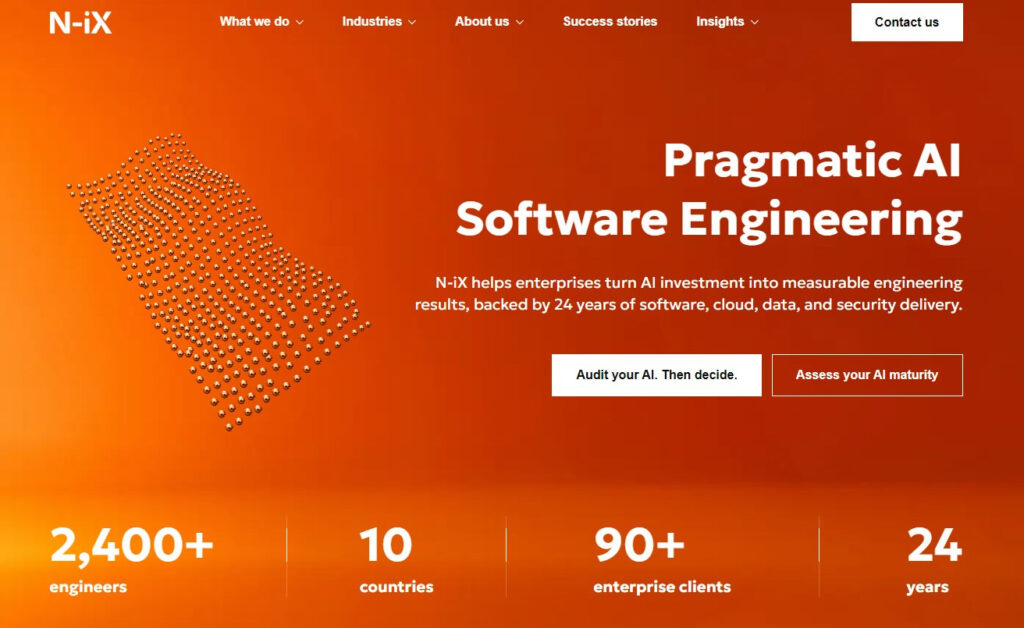
N-iX holds 350 active certifications across Microsoft, AWS, Google Cloud, Palantir, SAP, and Snowflake. The firm became an AWS Premier Tier Partner with an AWS AI Services Competency earned in March 2026.
That matters for budget control. AWS Premier partners get better pricing. Those savings can pass to the client.
The company runs a four-phase program for AI-augmented development. Phase one is a two-week assessment. N-iX engineers work inside the client’s codebase. They document every potential AI workflow. They size every gap. They cost every opportunity.
If nothing makes financial sense, the engagement stops there. No hard sell.
Phase two is a four-to-six-week pilot. Three to five AI workflows run on real code with real engineers against a baseline agreed at the start. The numbers either move or they do not.
A SaaS company with 250 engineers moved from zero AI usage to 28 percent AI-generated code in six weeks. Code review time dropped 42 percent. The company did not hire new staff. They did not buy expensive new tools.
A US transportation company with 140 engineers saw a velocity up 27 percent. Test coverage climbed from 55 percent to 81 percent. Hotfix deployment time dropped 70 percent.
A housing management platform with 150 engineers cut regression testing from three days to four hours. Incident resolution dropped 87.5 percent.
N-iX does not sell AI features for the sake of AI features. They measure everything against the client’s actual infrastructure. If a chatbot or recommender does not move a business metric, they say so.
That honesty keeps budgets intact.
3. Geniusee
Best for: Agencies serving enterprise clients who demand certified security and compliance.
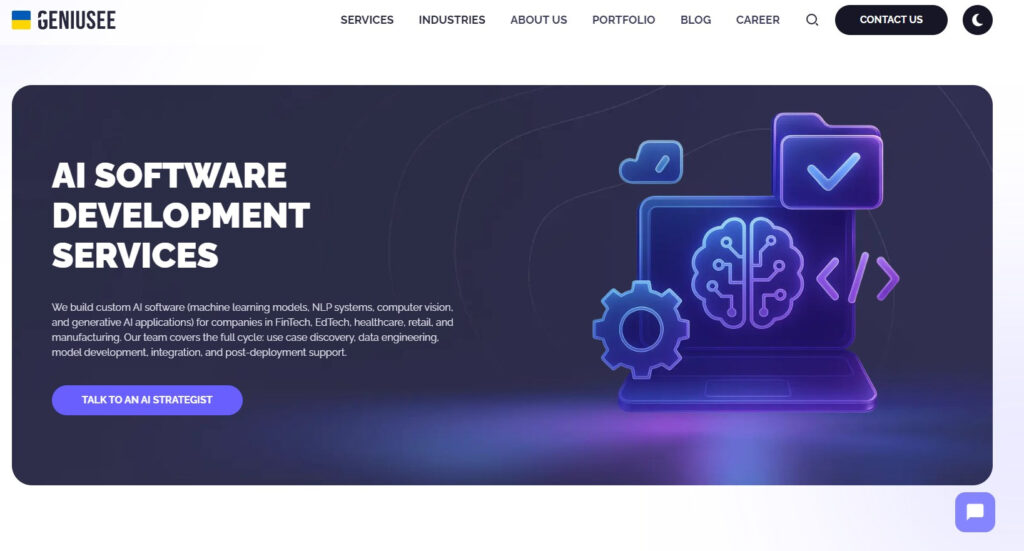
Some agency clients require paperwork. ISO certifications. AWS partnerships. Audited security protocols.
Geniusee carries those papers. The firm holds AWS Advanced Tier Services Partner status with an AWS AI Competency. ISO 9001 for quality. ISO 27001 for information security. ISTQB Platinum Partner certification for QA.
A team of 300 engineers, data scientists, and cloud specialists runs operations from US headquarters with delivery hubs in Ukraine and Poland.
Geniusee built an AI-powered predictive marketing platform called Wyzoo (now Xperra). The project included ETL pipelines for data cleansing and AutoML tools like H2O Driverless AI. Custom models handled customer segmentation and response prediction. The client got a working platform. They did not pay for months of research.
For the Compose AI partnership, Geniusee handled cloud migration and UX improvements for a YC-backed startup. No over-engineering. Just stable integrations and faster performance.
The firm’s engineers use AI-assisted tools like Cursor and Copilot to speed up routine work. That efficiency gets passed to the client. Lower hours. Lower bills.
Agencies working with enterprise clients often cannot promise compliance themselves. Geniusee provides the certifications under the agency’s brand. The end client never needs to know.
Fixed-price engagements are common. The firm starts with a discovery phase to scope exactly what the website needs. No AI features added just because they sound impressive.
4. Scopic
Best for: Agencies that need AI features added to legacy systems without rewriting everything.
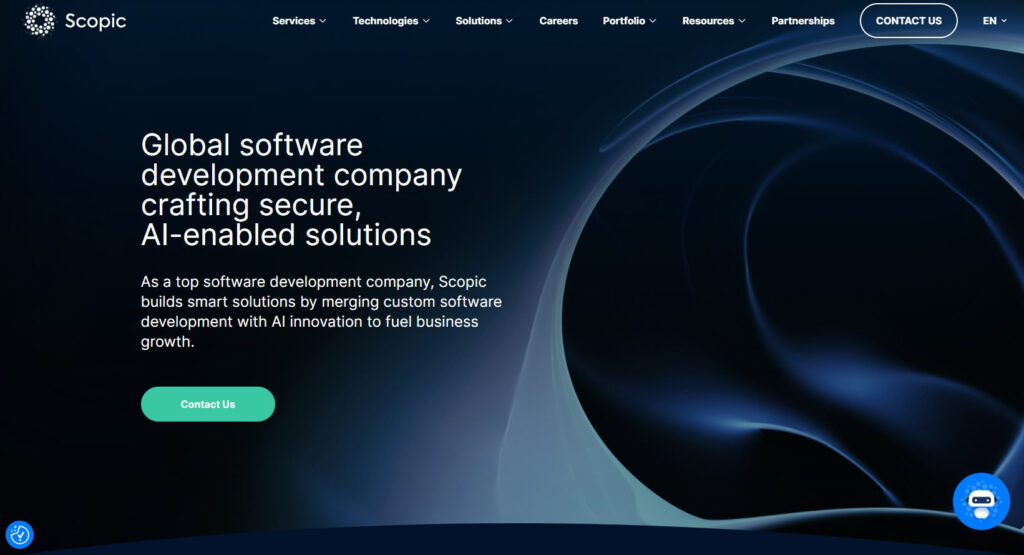
Scopic runs a distributed team of 200+ software developers and 20 AI and ML engineers. The firm has operated since 2005.
Their AI integration practice focuses on connecting third-party tools rather than building from scratch. OpenAI, Google AI, and IBM Watson get dropped into whatever systems the agency’s client already runs. CRMs. ERPs. Cloud platforms. Old databases from 2010.
The agency’s client keeps their existing tech stack. The AI capabilities just appear.
Scopic built an end-to-end MLOps infrastructure for MedCAD, a medical imaging company. Automated retraining and validation workflows cut delivery time by 50 to 60 percent. Complete traceability links every model to its exact dataset and code version. Regulatory compliance ready with full audit trails.
For a different client, Scopic built an internal dashboard called Scopic People in 9 hours. Traditional estimates put the project at 80 to 100 hours. AI handled service layer design, role-based access control, Docker configuration, and PostgreSQL integration.
The firm offers fixed-price quotes. Free consultations define requirements before quoting. Daily reports go through whatever channels the agency prefers.
Agencies with clients on older systems often hear “you need a full rebuild” before adding AI. Scopic says the opposite. Keep the old stuff. Add a smart API layer on top. Pay for the integration, not the rebuild.
Comparison of Budget-Friendly AI Delivery
The table below shows how each firm controls costs differently.
| Firm | Cost Control Method | Fixed Price Available | Typical AI Feature Cost Range |
| GetDevDone™ | Single-feature scope, off-the-shelf algorithms, white-label agency model | Yes | Low to mid five figures |
| Geniusee | Discovery-first scoping, AI-assisted developer tools, ISO-certified efficiency | Yes | Mid five figures |
| N-iX | Two-week assessment before any billing, AWS Premier pricing passed to the client | Yes | Mid to high five figures |
| Scopic | Third-party tool integration instead of custom builds, distributed team rates | Yes | Low to mid five figures |
Those ranges only matter if the work ships.
Bottom Line
A single working feature beats a platform that never launches. That is the difference between these four firms and the ones that waste budgets.
GetDevDone™ delivers one AI feature at a time using off-the-shelf algorithms. Geniusee starts with a discovery phase and stops if the numbers do not work. N-iX runs a two-week assessment before any billing begins. Scopic connects third-party AI tools to existing systems instead of rebuilding them.
Each firm will quote a single price before starting. No separate line items for research. No surprise cloud fees. Just a number and a delivery date.
Ask any potential partner for that one number. The firms that respect budgets will provide it immediately. The ones that do not will start talking about complexity.