

Half of UK fintech startups say payment friction is their biggest barrier to scaling. Yet choosing the right Open Banking infrastructure is harder than it looks.
These platforms provide unified APIs for real-time bank data (AIS), Pay by Bank (PIS), and verification. Each one focuses on different areas — embedded finance, subscriptions, crypto onboarding, or cross-border payouts. Founding years range from 2008 to 2019, so maturity varies. Some prioritise transaction accuracy, others focus on payment volume.
Below we rank them by actual API coverage, proven throughput, and transparent pricing — not marketing.
These 10 differ in measurable ways:
| Firm | Best for | Founded | Notable specialty | Coverage |
| Finexer | Scaling SaaS platforms | 2019 | 99% UK bank coverage | UK-first |
| Plaid | Consumer fintech & lending | 2013 | 12,000+ bank connections | 20 markets |
| TrueLayer | Pay by Bank volume | 2016 | 50% UK market share | UK/EU |
| Tink | European data aggregation | 2012 | 3,000+ EU connections | 18 countries |
| Bud Financial | Transaction enrichment | 2015 | 98% categorisation accuracy | UK/EU |
| Salt Edge | White-label infrastructure | 2013 | 5,000+ global banks | 50+ countries |
| Volt | Real-time payment schemes | 2017 | Cross-border instant rails | Global |
| Brite Payments | 24/7 instant payouts | 2019 | 3,800 EU banks, zero cut-off | Europe |
| GoCardless | Recurring Direct Debit | 2011 | 350+ software integrations | 30+ countries |
| Trustly | Conversion optimisation | 2008 | Azura personalisation engine | Global |
What Open Banking API Platforms Do
Open Banking platforms connect businesses to bank accounts for real-time data and secure account-to-account payments via standardised APIs. The sector came from PSD2 in Europe and similar regulations elsewhere that required banks to open their data.
Users usually fall into four groups:Users usually fall into four groups: fintech consumer apps, SaaS platforms adding payments, B2B platforms verifying bank data, and enterprises modernising account-to-account payment flows.
The main challenge is clear — integrating with thousands of banks directly is impractical. These platforms fix that by offering one single connection.
Most give you access across Europe without needing individual bank setups or your own PSD2 licence. They typically support AIS (transaction data) and PIS (instant payments), though each platform has its own strengths — some focus on payment volume, others on data enrichment or verification workflows.
How to Choose an Open Banking API Provider
There’s more to choosing an Open Banking provider than most lists suggest. Focus on these practical points:
- Reach vs focus: 12,000+ banks across 20 markets for global scale, or 99% UK coverage for local strength. Cross-border teams usually need both.
- What’s included: Full-stack providers combine data, payments, verification and payouts in one setup. Data-only options mean extra integrations down the line.
- Pricing clarity: Free sandboxes with decent live calls are essential for testing. Volume pricing works at scale; per-transaction fees suit startups. Request-a-quote often means enterprise-only.
- Real performance: One provider processes almost half of UK Pay by Bank volume – over 2x the nearest rival. Published numbers beat marketing fluff.
- Data quality: 98% enrichment accuracy is critical for finance and underwriting apps. Real-time categorisation beats batch processing.
- Compliance & security: FCA authorisation and PSD2 are table stakes. ISO 27001 and shared audit reports add credibility.
Top Open Banking APIs for Fintech
Selecting an Open Banking API determines your payment performance and long-term costs. From data aggregators to instant payment engines, here are the top platforms based on their core focus and geography.
Finexer
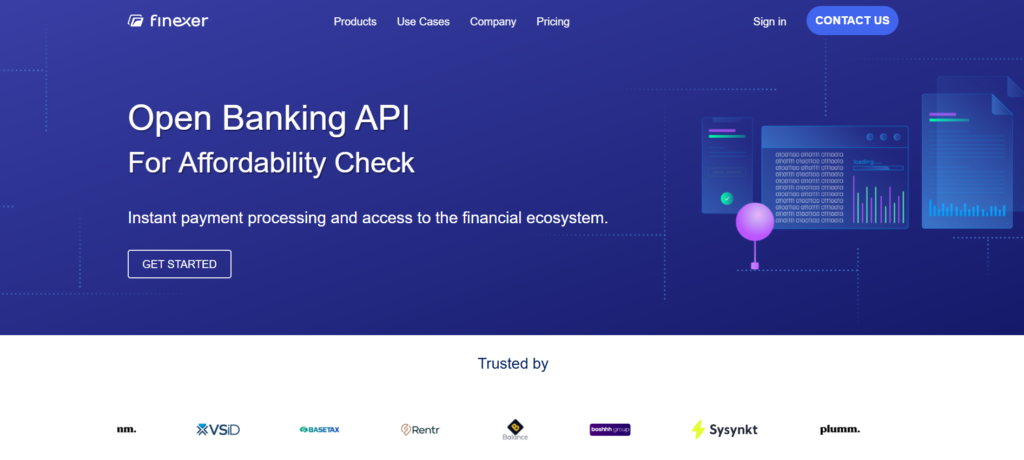
Finexer is a UK-based, FCA-authorised Open Banking infrastructure provider built for scaling SaaS platforms.
Founded in 2019, the company delivers 99% UK bank coverage with real-time, audit-ready financial data through a single API combining Account Information Services, Payment Initiation Services, and verification workflows.
The platform enables UK-focused businesses to access permissioned bank data and initiate Pay by Bank payments through Open Banking.
The feature set includes Bank Transactional Data, Instant Payments, Batch Payouts, Bank Feed, Expense & Income Data, Identity Verification, and Data Aggregation, supporting a range of Open Banking payment and financial data workflows for SaaS platforms.
| Feature | Detail |
| White label | Custom HTML/CSS rendering for consent journeys |
| Pricing | Startup tier with discounted rates, standard tier, enterprise volume-based |
| Account setup | Regular business accounts accepted |
| Dashboard | Full-feature access regardless of plan tier |
Finexer differentiates on deployment speed: built for scaling platforms with faster deployment cycles and flexible, usage-based pricing. The platform’s unified API design reduces the engineering lift compared to stitching together separate AIS and PIS providers.
Plaid
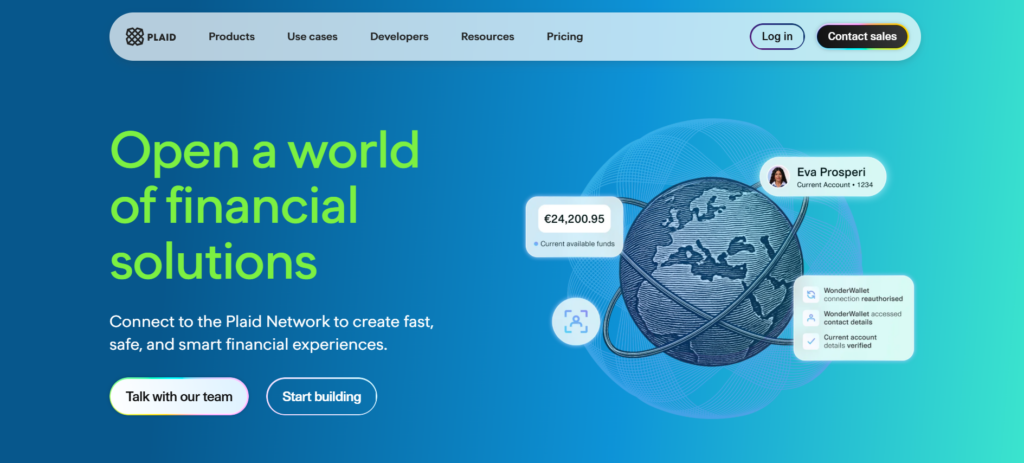
Plaid serves as the main infrastructure choice for US fintechs moving into lending, personal finance, and identity verification.
Since 2013, it has built the world’s largest open banking network, linking to 12,000+ financial institutions across 20 markets with over 100 million users. Businesses use it to connect bank accounts, access real-time data, and run secure payments.
The platform offers broad coverage, including account linking, payments, fraud prevention, income verification, KYC/AML, and balance checks. It operates under PSD2 with proper AIS and PIS authorisations in the UK and the Netherlands.
Key advantages:
- Huge user network that boosts fraud detection.
- Free sandbox with generous live API calls.
- Strong US bank integrations.
- Good support for enterprise plans.
Fintechs and enterprises rely on Plaid for faster onboarding, underwriting, cash flow insights, and instant payments.
TrueLayer
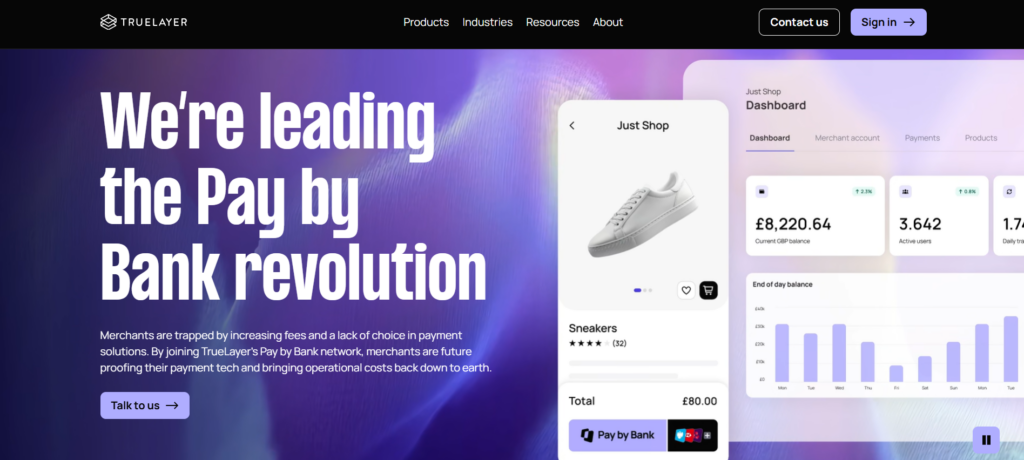
TrueLayer handles the largest share of UK Pay by Bank payments. Its enterprise-grade setup is tailored for high-conversion ecommerce and travel flows.
Since launching in 2016, the UK provider has built a single API platform for instant payments, payouts, and financial data. It now accounts for nearly 50% of UK Pay by Bank volume — more than double its closest competitor — and serves over 20 million users, adding around 1 million new ones each month.
Businesses get Pay by Bank, instant payouts, recurring payments, verification tools, and real-time data across Europe. Everything connects directly to bank accounts, making payments, onboarding, and checks faster and less reliant on cards.
| Product | Use case |
| Pay by Bank | Instant checkout payments with lower fees than cards |
| Payouts | Real-time refunds and supplier payments |
| Bank on File | Stored bank credentials for recurring payments |
| Verification | Identity and account ownership checks |
| Data API | Transaction history and balance access |
The feature set includes Pay by Bank payments, payouts, Bank on File, Data API, verification, user incentives, Signup+, and verified payouts. The company focuses on reducing payment friction, lowering transaction costs, and improving conversion rates for e-commerce, fintech, travel, gaming, and financial service businesses.
Tink
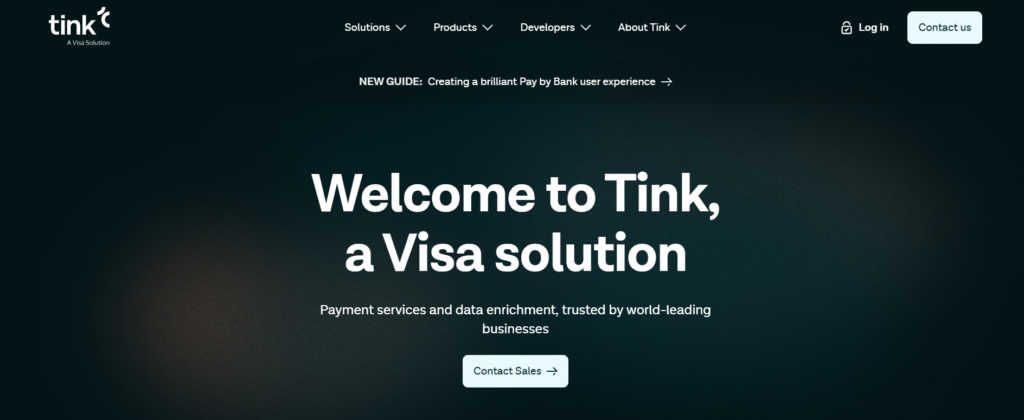
Tink is Visa’s European Open Banking platform. It stands out for offering the deepest bank connectivity across Europe for data and payments at scale.
Since its founding in 2012, the company has built connections to more than 3,000 banks. One API gives access to financial data across the continent.
It provides solutions for Pay by Bank, payouts, transaction aggregation, balance checks, income verification, expense analysis, and risk insights. Both consumer and business data are supported, making it easier to build faster payments, improve credit decisions, and streamline verification processes.
Pros:
- Backed by Visa’s infrastructure and compliance resources.
- 4 background refreshes every 24h for data aggregation.
- Account aggregation, payment initiation, income verification, account checking, data enrichment, risk decisioning, customer onboarding, and invoice settlement.
- PSD2-compliant cloud-based APIs and developer SDKs.
Tink connects thousands of European banks via PSD2-compliant cloud APIs and SDKs, with data enrichment and risk analysis to standardise financial data and generate actionable insights.
Bud Financial
Bud specialises in AI-powered transaction enrichment and customer intelligence. It helps banks and financial companies turn raw, messy transaction data into clear, actionable insights for personalised digital experiences.
Founded in 2015, Bud works as the customer intelligence layer on top of banking data rather than a traditional payment provider. Its main strength is a market-leading 98% transaction enrichment accuracy, backed by strong AI and machine learning.
The platform includes features such as:
- Transaction enrichment — cleans and categorises raw bank data into structured, searchable information.
- AI-powered search — lets users run natural language queries across their transaction history.
- Customer segmentation — groups users by spending patterns for better product recommendations.
- Credit risk assessment — analyses income and spending behaviour to support lending decisions.
Salt Edge
Salt Edge delivers a wide-ranging Open Banking infrastructure with white-label support. It helps banks and fintechs expand across multiple markets without needing their own PSD2 licence.
Founded in 2013, the company connects to 5,000+ banks in 50+ countries. This broad coverage is one of its biggest advantages.
Businesses use it for data aggregation, payment initiation, account information services, KYC/onboarding, personal finance tools, multi-banking, real-time data access, and mobile authentication. Salt Edge brings over a decade of experience plus solid security credentials, including ISO 27001.
Salt Edge supports all major API standards, including the Berlin Group, UK Open Banking, CDR (Australia), Saudi Arabia, Brazil, FDX (US), and more. The platform is particularly strong for businesses needing multi-market coverage without managing separate regional integrations.
Volt
Volt specialises in unifying real-time payment schemes across borders. This allows instant cross-border commerce with one straightforward API.
Since its founding in 2017, Volt has created a global account-to-account payment infrastructure. Businesses can send and receive instant transfers across countries and banking systems using a single integration.
The platform connects to thousands of banks and local payment schemes. It supports Pay by Bank, payouts, refunds, and virtual accounts, helping companies move away from cards and traditional intermediaries.
Main use cases:
- E-commerce: faster checkouts at lower cost.
- Crypto: quick fiat on/off-ramps.
- iGaming: rapid deposits and withdrawals.
- Wealthtech: instant account funding.
Volt provides Instant Payments, Refunds, Payouts, Virtual IBANs, and strong fraud protection. Its network covers hundreds of millions of accounts globally.
Brite Payments
Swedish instant payment specialist operating a 24/7/365 payment network across 3,800 European banks with near-zero fraud and no bank cut-off times.
At Brite Payments, we create smarter, faster, more financially sustainable ways to pay and be paid. Founded in 2019, the company built a proprietary Instant Payments Network (IPN) connecting over 3,800 European banks operating 24/7/365 with near-zero fraud and chargebacks.
The platform offers Instant Payments, Instant Payouts, Data Solutions, Account Verification, Account Details, Account Balances, Transactions, and Income Insights. Brite differentiates by eliminating reliance on traditional card networks and bank cut-off times — payments settle instantly regardless of time or day.
| Differentiator | Impact |
| 24/7/365 availability | No weekend or holiday delays |
| Near-zero fraud | Direct bank authentication reduces chargeback risk |
| 3,800 EU banks | Broad European coverage through single integration |
| Instant settlement | Real-time liquidity for merchants |
Brite AB is a licensed Payment Institution under the supervision of the Swedish Financial Supervisory Authority (Finansinspektionen). Brite AB provides payment services under the Swedish Payment Services Act (2010:751) and the PSD2. The company focuses on regulated, secure instant payments for European merchants.
GoCardless
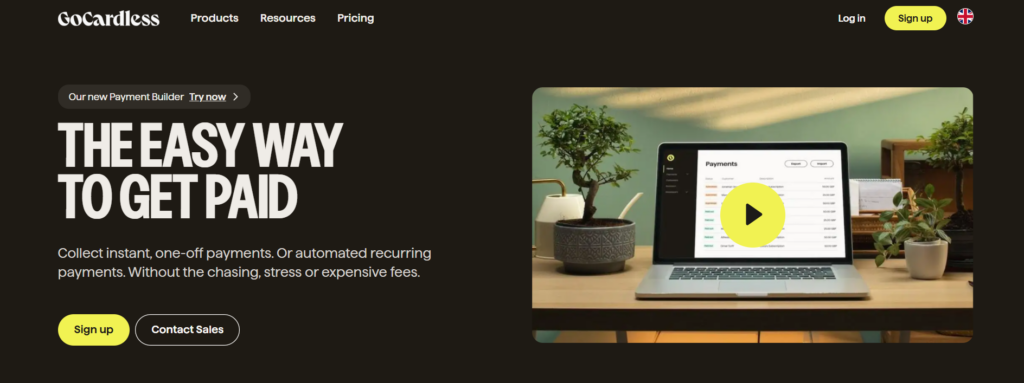
Leading Direct Debit automation platform for subscription businesses, offering recurring payment infrastructure integrated with 350+ accounting and billing systems.
GoCardless is a global bank payment platform that helps businesses collect one-off and recurring payments directly from customer bank accounts. Founded in 2011, the company focuses on simplifying payment collection through automated bank debit infrastructure.
GoCardless provides solutions for instant Pay by Bank payments, recurring Direct Debit collections, subscription billing, invoicing, and international bank payments across more than 30 countries. Its platform supports automated payment retries, payment tracking, reconciliation, and integrations with over 350 accounting, ecommerce, and business software systems.
Pros / Cons:
| Strengths | Limitations |
| 350+ software integrations (Xero, QuickBooks, Salesforce, etc.) | No published API feature list |
| Automated retry logic for failed payments | No transparent pricing tiers |
| FCA-authorised under Payment Services Regulations | Focus on Direct Debit (less instant payment emphasis) |
Designed for businesses ranging from small companies to large enterprises, GoCardless helps automate payment operations, reduce manual admin work, and improve cash flow management. The platform is particularly strong for subscription services, instalment payments, and recurring billing workflows.
Trustly
Trustly stands out as an experienced Pay by Bank provider that handles billions in yearly volume for e-commerce, travel, and gaming companies.
Since launching in 2008, it has built one of the most established Open Banking networks. Merchants use it for instant account-to-account payments, recurring billing, deposits, payouts, and financial data services.
Notable features:
- Azura AI engine for personalised checkout flows and better conversion.
- Strong presence in ecommerce, travel, gaming, and subscriptions.
- Support for instant payments, recurring transfers, payouts, and verification.
You can integrate directly or via major PSPs. Trustly manages the whole process from start to finish.
Conclusion
We ranked these Open Banking platforms based on six practical criteria: bank coverage, payment throughput, feature range, pricing transparency, regulatory strength, and years in operation. All data comes from official public sources only.
The smartest move is to test before committing. Most providers give free sandbox access — use it to check API performance and data quality. In this category, real technical fit beats brand reputation every time.